There is an empty teacup in this story, and more than forty strands of ribbon cable, and a bus.
The teacup sat in the window of an antique shop in Insa-dong, Seoul, in 2002. A graduate student who had just spent six months failing to build a speech-recognition engine stopped in front of it and understood, all at once, why he had failed. The ribbon cable was soldered, stitch by stitch, across an eight-layer circuit board in a New York laboratory in the winter of 2008, by a twenty-nine-year-old immigrant whose English was still halting and whose company would not have survived without it. The bus was in Seoul, in the summer of 2008. A father held his infant son on it and wept, and by the time he stepped off he had decided to cross the Pacific.
Edison Yu was born in Jusuri, a village in Okgye-myeon near the East Sea coast of Gangwon-do, South Korea, where his mother has farmed green onions for more than fifty years. At six he watched a black-and-white television and decided to become the engineer who built it. He went on to write the firmware for the world’s first four-input HDMI 1.0 card, to design a commercial LCD television from the mainboard up, to ship the industry’s first 4K 8×8 HDMI matrix switcher, to earn two granted United States patents (US 8,930,610 and US 9,210,352), to put a 1,024-by-1,024 virtual matrix onto network switching instead of a dedicated box, and, when a global chip shortage threatened to halt Key Digital’s flagship product, to write an emulation of one semiconductor inside another so that a third would never notice the difference.
He will tell you that none of that was the point. Looking back across forty years, he found a single word running through all of it: connection. A telephone line into a modem in 1994. Video over copper, then over a single category cable, then over IP. And, from the chief technology officer’s chair, the connections inside a company itself: between its products, its suppliers, its departments, and its decisions.
How did a boy from a small village on Korea’s east coast become a chief technology officer, a technology executive, and an engineering philosopher?
This is his story, told in ten parts, with a selection from his personal archive at the end. It is a true account, told from his own recollection; nothing in it has been invented. The Executive Profile explains the career and the Engineering Philosopher explains the thinking. This biography explains the journey.
At a glance
- Born
- Jusuri, Okgye-myeon, Gangneung, Gangwon-do, South Korea
- Education
- Control and Instrumentation Engineering, School of Electronic Engineering, Kangnung National University (currently Gangneung–Wonju National University) (1998–2002) · Master’s, School of Electrical and Electronic Engineering, Sungkyunkwan University, Human-Computer Interaction Laboratory (2002–2003)
- Career
- Infinix, Seoul (2004–2005) · Macro Image Technology, Seoul (2005–2008) · Key Digital, New York: Senior System & Hardware Engineer, part-time contractor (2008), full-time from October 2009 as Director of Engineering, Chief Technology Officer (2019)
- Patents
- Two granted United States patents for IQJUMP™ and control over HDMI: US 8,930,610 (January 2015) and US 9,210,352 (December 2015), filed under the name Ilsoo Yu
- Home
- Fort Lee, New Jersey, since 2011; United States citizen since 2020
- Now
- Chief Technology Officer, Key Digital, since 2019 · Fort Lee, New Jersey
The life in dates
Each entry links to the chapter where it happens.
Six years old, a black-and-white television, and a vow written into a school record: Engineer.
Student body president; a three-year scholarship; C, C++ and Java, self-taught.
A club of two hosts the 1st National University Line Tracer Competition.
The iSync HD. First trip to New York. More than a month in a warehouse room. “You are a Superman!”
The MLT-210: a commercial LCD television, designed from the mainboard up with his own hands.
The Single CAT HDMI Extender, ahead of HDBaseT. The HDMI Fixer. A daughter.
Delta Air Lines headquarters, Atlanta: an overnight firmware build in a hotel room.
United States citizenship and the legal name Ilsoo Edison Yu. COVID-19, nearly fatal.
The chip crisis. A Lattice HDMI chip emulated, bit by bit, inside a microcontroller.
Pandemic-era supply-chain shocks and a corporate restructuring at Key Digital. He stays.
Hundreds of books and long walks: twenty years of work, reconsidered.
Twenty-two years in engineering and leadership; still Key Digital’s Chief Technology Officer.
Part One 1980s – 1997
The Boy at the Dumping Ground
A black-and-white television, a heap of discarded circuit boards, a green onion field, a 660,000-won computer, and the telephone line that reached a mountain village in 1994. How a boy on Korea’s east coast decided what he would become, and what his friends would call him.
A Six-Year-Old’s Vow
Jusuri, Okgye-myeon, Gangneung · 1980s
The set was small and the picture came in black and white. In the corner of a room in Jusuri, a village in Okgye-myeon on the edge of Gangneung, in Gangwon-do, a six-year-old boy turned the channel dial and listened to the crackle of white noise until a picture steadied out of the gray. People moved. Streets in distant Seoul filled the cold glass. A moment earlier the box had been dark and silent. Then electricity ran through it, radio waves no one could see touched it, and a living world appeared, as if by magic.
Jusuri lay between the mountains and the sea, and both closed it in. To the boy, the television was no mere appliance. It was a window, a “Window of Connection,” the one opening that joined his small room to everything beyond it.
Watching the tube glow that day, he made the first vow of his life, and it would run through everything that came after.
“When I grow up, I will become the engineer who builds this television.”
Children say such things. This one did not let it go. When he started elementary school and the class was asked to fill in the “Future Aspirations” column of their student records, the others wrote president, scientist, doctor. He wrote “Engineer,” clearly, without a millimeter of hesitation. The record book survived. In 2026, faded and worn, it sits in a corner of Edison Yu’s study, kept like a jewel. It is the first blueprint of his life, the proof of where he started and the first oath he ever made to himself.
About a year later the vow found a face. At seven he read a children’s biography of Thomas Edison, the inventor who lit cities and taught machines to record sound, and decided that this was the kind of engineer he would be. The book stayed with him for the rest of his life, and so did the name.
What was inside the box? What could pull voices and faces out of the air and set them moving behind glass? The boy wanted to see for himself and to hold it in his hands. So he went where the broken televisions went. He went to the dumping ground.
Other children had plastic toys and ball games. He had the neighborhood’s heap of discarded electronics, and it was his playground and his treasure chest at once. He dug through it for the green fragments of printed circuit boards snapped from the insides of shattered televisions and dead radios. Under the grime, each board was crowded with components he could not yet name. Resistors striped with colored bands. Cylindrical capacitors. Black transistors and IC chips standing on their many legs. Coils wound tight with copper wire. Packed together they looked like the skyline of a miniature city from the future. To everyone else they were trash. To him they were the most exciting toys in the world, and he played with them every single day.
At home he spread the parts across the floor and stared at them for hours. With a fingertip he followed the silver solder joints and the copper traces that ran over the back of each board like a spiderweb, working out which leg went where and how a signal might travel. He knew no circuit theory and none of the proper names. But his hands were already learning the most basic rule of hardware. Separate components, joined by physical lines, become a single living thing.
The family lived by physical work. His father worked in the mines, and his mother grew vegetables to sell at the local market. Nobody in the house had time for idle hours, and the children did not either.
There was a second world in his childhood, and it was far less forgiving. During his elementary school years his mother began farming green onions, work she has kept up for more than 50 years and continues to this day. For the boy it was not optional. After school and on weekends, his days belonged to the field, from the time the sun came up until it went down.
Planting green onions meant squatting under the summer sun and working down furrows that seemed to have no end. He hated it. It was hard in a way that hurt. But he did not complain and he did not cut corners. He moved his hands faster than anyone, and in the whole neighborhood the fastest planter of green onions after his mother was this boy.
His body was in the dirt. His mind was somewhere else. With sweat dripping from his chin, he would look over at his mother bent double over the rows and tell her what he saw coming.
“Mom, one day a machine that plants green onions is definitely going to come out. If it doesn’t, I’ll build one myself when I grow up. Twenty years from now, robots will be doing the farm work instead of us.”
“Stop talking nonsense and move your hands faster. Do your work.”
She laughed about it with the neighborhood adults, too, her son and his absurd talk of a green onion planting machine. To the boy it was no joke. Every seedling he pushed into the soil was one more repetition of a motion a machine ought to be doing, and he thought about the rice transplanters that were already planting the paddies. In his head, again and again, he drew the design. Mechanical arms and a conveyor would separate the seedlings and set them into the ground at even intervals and at a constant depth. Exactly 20 years later a commercial “automatic green onion transplanter” came onto the market, and its structure matched the one the boy had drawn in his head in that field to an astonishing degree.
A vow in front of a television. The word “Engineer” in a school record. A floor covered in salvaged circuit boards, and a planting robot designed in a field of sweat. Read backward from everything that followed, these were the opening lines. At the time they were simply what a boy in Jusuri did with his days.
The 660,000-Won Computer
Okgye-myeon · Early 1990s – 1994
At the end of a day in the field, the boy washed the dirt from his hands, came inside, and turned on the television. Through elementary and middle school, that was the whole of his free time. Farm work left no afternoons for kicking a ball around or chatting with friends; he saw them in class and on the walk to and from school, and that was all. Hobbies and after-school activities were out of the question. The glowing tube was his sanctuary and his one channel to the world outside.
It never lost its wonder. After a day outside, covered in dust, facing that screen was a joy in itself. The world inside the set had nothing in common with the village he stood in, and the Seoul it showed him was a dream city he could not reach. He watched it and wanted, badly, to get past the mountains and the sea and connect with whatever lay beyond.
The turning point came around the sixth grade, and it began with hurt pride. A computer academy, the first the township had ever had, had opened its doors, and one by one his friends were starting to attend. To the boy a computer was a mysterious object he had only ever seen on television. Then his mother heard something unpleasant from the neighborhood women. It stung, and partly to salve her pride and partly to lift her son’s spirits, she told him to enroll. So the boy stepped into the first and last private academy of his life.
What he found there was a boxy black PC running MS-DOS. There were no pictures, only a cursor blinking after a C:\> prompt on a dark screen, and next to today’s machines it was crude. To the boy it was the most mysterious and extraordinary device in the world. He typed a command and the machine answered at once, and in that instant he understood something about himself.
“I have an extraordinary talent for computers!”
The family could afford six months of tuition, and that should have been the end of it. But the academy’s director had been watching the boy’s concentration, and he recognized at a glance what he had in front of him. He made an offer no one else in the room received.
“I won’t charge you tuition from now on. Come to the academy and teach the other kids your age how to use the computers.”
So the boy became a teaching assistant to children his own age, and for more than a year, until middle school, he attended for free. He had the machines to himself for as long as he liked, he rode home comfortably on the academy bus, and his skill grew by leaps and bounds.
The more he learned there, the more one wish burned in him. He wanted a computer of his own, at home, that answered to no one but him. He begged his mother for one every day. He did more than beg. He worked her fields harder than ever, and he volunteered on other families’ farms for pocket money, sweating his way toward the price.
The year he finished elementary school, his effort and his parents’ enormous decision came together, and a 660,000-won computer came into the house. His father earned 300,000 won a month. The machine cost more than two months of everything the family lived on. To the boy it was a sacred object.
He still remembers the thrill of switching it on for the first time. Of all the gifts he has received in his life, he counts it as the greatest.
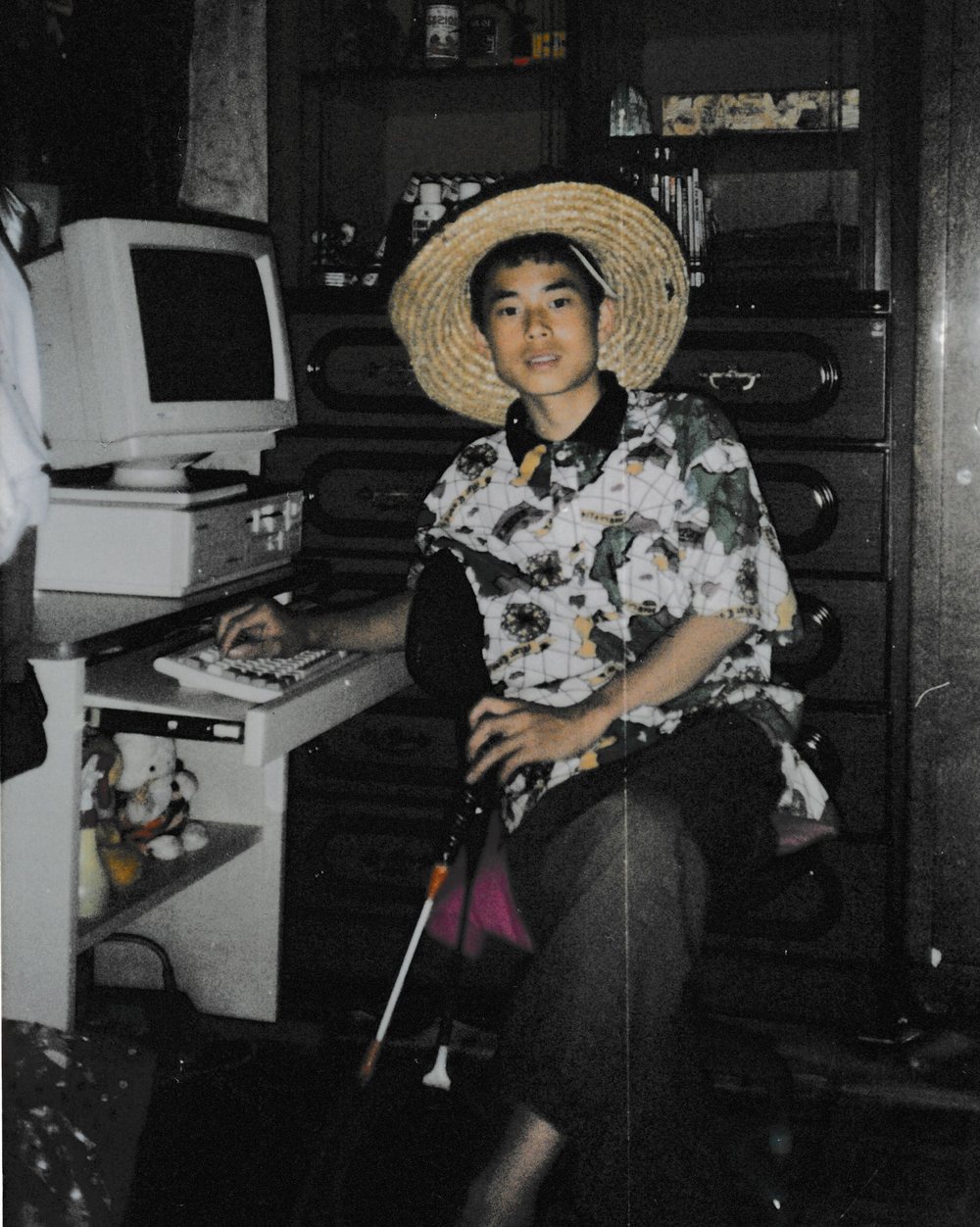
Then came 1994. The internet and PC communication were spreading across South Korea, and the telephone network reached far enough that even Okgye-myeon could dial in. In his small room, back from the field, the boy plugged the phone line into the modem of the 660,000-won computer. A long electronic tone filled the room, then a burst of hiss and crackle, the sound of two machines shaking hands across the wire.
With that sound, the isolation of a village hemmed in by mountains and sea simply gave way. He did not have to go to Seoul. He did not need the private tutors that wealthy children had. One connection line was enough, and a boy from a mountain village could reach any information and any person in the world. He felt it as a liberation. Years later, looking back across a career spent connecting things, this was the experience he would name as its purest origin: a telephone line plugged into a modem in a small room in Okgye-myeon in 1994.
Five Streams into One Classroom
Okgye-myeon · Middle school years
Five elementary schools fed into the single middle school of Okgye-myeon. They were scattered across the township, some by the sea, some in the fields, some deep in the mountain valleys, and for six years their children had grown up apart. Then, on the first day of middle school, a three-year program in Korea, all of them poured into the same classroom at once. They were strong-willed and rough, and they did not know one another.
In the 1990s the post of class president was understood to belong to a certain kind of student, the one with the best grades and the wealthiest parents. So in the first semester of the first year, the top student among the new arrivals was elected, as if it could not have gone any other way. His report card did not survive the semester. The children from the sea and the fields and the valleys would not listen to him. They talked over him and broke loose, and before long the teachers had branded the room “the most troublemaking class in the entire school.” The top student threw up his hands and resigned before the first semester was over.
Everyone else shook their heads. The boy thought quietly. His grades sat around the middle of the class, but he knew something about himself that no report card showed. He was good with rough kids. He could gather them and lead them.
“I should become the class president.”
His classmates elected him with enthusiasm. Teachers and parents still pointed at the room and called it “a class full of the school’s problem children,” and the boy did not give up on a single one of them. He did not try to hold them down with authority. He talked to them at their own eye level, and he held the center of the room.
It paid back in a way no one expected. In the second year his classmates re-elected him without hesitating. In the third year they did not bother to hold an election at all; they simply handed him the post again, unanimously. From admission to graduation he was class president, three years running, and he was the only student in the entire school to hold it for all three.
He was already looking past the classroom. Only third-years could run for student body president, but from his second year he was turning one question over and over. What speech would he give from the podium once he was the third-year student body president? He did not think of it as a hope. He thought of it as a date already fixed. Every day, on the dirt roads to and from school, he drafted that speech in his head.
When the third year came, something happened that no one would have predicted. The troublemakers of his class, the ones even the teachers had written off, nominated him for student body president themselves. Nobody asked them to. They made themselves his campaign headquarters and ran across the whole school on his behalf. The other candidates were the two most prominent honor students in the school, the ones who traded first and second place in the rankings. The boy’s grades were still upper-middle. But his class stood behind the leader who had never given up on them, and their cohesion carried the vote. He defeated the first- and second-ranked students in the school and became Student Body President.
The joy lasted until he walked down the hallway. A homeroom teacher from another third-year class saw the new president pass and said, in a sarcastic tone, a sentence he can still repeat decades later.
“How could a student like that be elected student body president?”
He knew what “a student like that” meant. His family was poor. His parents worked day and night to make a living, and in the three years their son served as class president and then student body president, they were never once able to visit the school. School events were carried instead by the wealthy parents of the vice president, who did their part and complained about it without end. A boy from the countryside with no money and no backing had taken the class presidency and then the student body presidency too. To the privileged, he was an eyesore.
Through all of it he had one adult quietly on his side. Shortly before middle school graduation, his homeroom teacher broke with custom. The “Full Three-Year High School Scholarship” went, by tradition, to the first- and second-ranked students in the school. The teacher recommended the boy instead, as a special recipient, and argued for him in earnest. Three years of responsibility, of refusing to abandon classmates everyone else had tried to abandon, of binding a whole school into one, were worth more than numbers on a report card or the wealth of a family. The teacher put his own name behind that claim.
Decades later, leading engineers and technical partners from several countries, and joining equipment from dozens of makers into systems that had to work as one, he would recognize the shape of the idea. He had learned it in a middle school classroom in Okgye-myeon, from children who came from the sea, the fields, and the mountain valleys, and from a teacher who believed he was worth a scholarship.
A Mother Tongue Made of Code
Gangwon-do · High school years – 1997
The words came from his mother, during his middle school years, and they came from exhaustion rather than cruelty. A hard life had worn her down, and she wanted her son to see the ground he was standing on.
“Our family is poor, so don’t even think about studying. And don’t go dreaming pipe dreams either.”
He had wanted to go on to a good academic high school in downtown Gangneung and study as hard as he liked on a wider stage. His mother shut that door firmly. It left a wound in his young heart that did not close for a long time. The one path still open was the high school where his homeroom teacher’s recommendation had won him the three-year scholarship, and he took it. He did not want to go against her, so he carried it quietly, as one more thing that had to be borne.
She must have been torn in half watching him. Her son was class president for three years and then student body president, and she could not actively support him. It is the particular grief of a parent who sees a bright child and cannot give him what he needs. Now that he has a family of his own, he understands the ache she swallowed then in a way he could not at the time.
Poverty was one constraint. Language was the other, and it tormented him almost as much. When he learned Hangul in the first grade, it came slowly. When he met the English alphabet in the first year of middle school, the same thing happened. Symbols with no context took him far longer to memorize than they took anyone else, and cramming endless English vocabulary was a kind of hell. He hated printed text itself. Novels, textbooks, anything in print, he did not want to read.
Then, at the computer academy, the boy who suffocated in front of human language met BASIC, and his world turned over. Programming was exhilarating. It was so much fun that he began teaching himself English in order to write it, because without English there was no way to code. The realization went through him like a current.
“Programming is the language that suits me! I can communicate with the world through programming. I can build anything I imagine. Soon, a world like that will surely come.”
A teacher at the academy added a practical note, and the boy’s ears caught it and held on.
“If you learn programming, you can become a programmer, make a lot of money, and you won’t even have to go to the military.”
He already dreaded the thought of the military, young as he was. A life in which he could earn a living, settle the military question, and spend his days on the coding he loved most was the best future he could imagine.
He went at programming in earnest once he reached high school. The middle school years as class president and student body president had cost him so much that on graduating he swore to himself, “I will never be class president or student body president again.” He kept the vow. Through all three years of high school, whenever an offer of a class post or a student office came his way, he declined it politely and poured every hour into teaching himself to program.
His first book on C came from a bookstore in the city, an hour away by bus. He had met the English alphabet only a year or two earlier, and the words the language was built on, for, if, while, switch, were not yet in his vocabulary. He worked through the book line by line, day after day, translating the English and the logic at the same time, until programming books began to read to him like novels.
He learned C and then C++ on his own. He mastered Java. Over the dial-up network he ordered a C++ compiler, and with it he built computer games from the ground up. He found that making a game was far more fun than playing one someone else had made; the pleasure was in watching a thing he had imagined actually work. Programming carried him over the hardships of his circumstances. It was his window onto the world and the one channel that broke through his trouble with language. The boy who hated every kind of book read programming books instead, and they were his Korean textbooks, his literature, his novels, and his comic books all at once.
His friends gave him two nicknames in those years. One was “Yu-Gura,” his surname joined to the Korean slang for a tall tale. The other was “Yu-Gyoju,” Yu the cult leader. He earned them by talking about the future. He thought deeply, imagined endlessly, loved philosophy, and described things that did not yet exist so vividly that his friends could almost see them. The question underneath was always the same one, how a human being ought to live. He held no religion and believed in no transcendent god. What he did believe in, firmly, was what he called the “Philosophy of Human Affairs.”
That teenage preoccupation never left him. In 2024, when he spent his evenings and weekends reading hundreds of books on history, philosophy, and management, what he was looking for was the thing he had been circling since his teenage years: an understanding of organizations grounded in a philosophy of human affairs.
Part Two 1998 – 2003
Robots, Tracers, and an Empty Teacup
A stepper motor pulled from a dead hard drive, a robot club that shrank to two members and then hosted a national competition, a private lab under the Dean, and a six-month failure in Seoul that ended in front of an antique shop window in Insa-dong.
A Steering Wheel from a Hard Drive
Kangnung National University (currently Gangneung–Wonju National University) · 1998
Inside a discarded computer hard drive, behind the platters, sits a small motor built to move a read head in exact, repeatable steps. In 1998 a freshman at Kangnung National University (currently Gangneung–Wonju National University) pried one out and set about making a robot steer like a car.
He had not planned to be in Gangneung at all. In 1997, with high school graduation approaching, the young man wanted a university in the Seoul area and the bigger stage that came with it. Money held him where he was, as it always had, and in truth he was far more absorbed in programming than in cramming for the entrance exams. So he did what he had done for high school and took the path that spared his family the tuition. In 1998 he entered Kangnung National University on a scholarship.
Within the School of Electronic Engineering, he did not choose computer science or general electronics. He chose the Department of Control and Instrumentation Engineering, because it was the discipline that sat closest to the thing he actually wanted to do. The boy in the green onion field had wanted machines and robots. The high school student had taught himself to code. Control engineering was where the two met and became working hardware, and the choice would make him an engineer at home on both sides of the line, in silicon and in software.
The first thing he did on campus was join KEM4328, the university’s microrobot club. The club built MicroMice, small autonomous robots that find their way out of a maze, and it was there that he first saw what robotics really was.
The seniors cared about one thing, a MicroMouse good enough to win maze competitions. The freshman cared about something else. He wanted autonomous driving. Even in 1998 he sensed that fully self-driving vehicles, of the kind that today’s Tesla FSD aims at, were on their way, and he wanted to build toward them.
“Instead of the MicroMouse the seniors are building, let’s build a Line Tracer that reads the line on the floor by itself, steers, and drives!”
He gave his whole freshman year to an independent Line Tracer, and along the way he learned that there was a national university competition for exactly that kind of robot.
This was where the dumping ground paid off. He was not satisfied with the usual trick of turning by running one wheel faster than the other. He wanted the robot to drive like a car. So he took an ultra-precision stepper motor out of a scrapped hard disk drive and built a steering mechanism for the robot’s front wheels around it, a mechanical automotive steering system that angled the wheels to an exact degree, designed and assembled entirely on his own.
He did the rest by hand as well. He designed the control board, the sensor board, and the battery and power board, and soldered every component himself; he cut the chassis and the wheels from thin aluminum sheet. It took six months of trial and error, and embedded C written from the first line, before the robot followed its first line on the floor. Later he built a far smaller tracer driven by tiny DC motors and programmed entirely in assembly language.
Then, at the end of his first year, the club turned upside down. There were about 20 first-year members, and the time came to elect the next president. He had sworn after middle school that he would never be class president or student president again, and he meant it; he had no interest in the club post either. A classmate from his department, the most popular of the first-years, was elected, as everyone expected.
Not long afterward, that new president announced he was quitting. He walked out, and the rest of the first-year members walked out with him. Of 20, two were left. The young man and his best friend stood in a club room that had emptied around them. It was the first year of middle school all over again, the top-ranked class president resigning and the room falling apart behind him. If no one acted, KEM4328 would simply dissolve. So he took the presidency he had vowed never to touch, his best friend took the post of general affairs manager, and the two of them walked into their sophomore year as the entire club.
A Track in the Lobby, a Nation on the Beach
Gangneung · March – Fall 1999
In the middle of the Engineering Building lobby, where every new student had to pass, two sophomores laid down a full-size Line Tracer track and set a robot loose on it. The robot found the white line and tore around the course on its own. Freshmen stopped to watch. That was the point.
The spring semester of 1999 had opened with the new club president setting himself an outsized goal, and he started on it immediately. KEM4328 would host the 1st National University Line Tracer Competition, at Kangnung National University (currently Gangneung–Wonju National University), that same year.
A competition is run by people, and a club of two cannot run one. The first task, then, was to recruit as many incoming freshmen as possible, and he and his best friend, now the general affairs manager, worked out how.
“Just putting up posters won’t make freshmen walk in on their own. Let’s show them with their own eyes what a Line Tracer actually is.”
Hence the track in the lobby, the robot running the white line at full speed in front of the passing crowd, and the two of them urging anyone who stopped to sign up. It worked beyond anything they had hoped. In one sweep, more than 30 incoming freshmen joined the club.
Then he had to make them robot builders. He ran in every direction to make sure each new member could build a Line Tracer of their own. He secured support funds from the College of Engineering and the Student Council so that the juniors could build their robots while spending very little of their own money. None of them had programmed before, so he taught them C and microcontroller coding himself, and he stood beside them through circuit fabrication and debugging, giving everything he knew.
The main event would be in the fall. Before then he traveled to the University of Seoul, where the first competition of the season was being held, for two reasons. He competed, and he sought out the organizers to learn, with his own eyes, how a national-scale competition is prepared and run on the day. When summer vacation began, he and the 30-plus freshmen went to work in earnest.
The work was physical and there was a great deal of it. The arena had to be built from scratch. They bought dozens of large plywood boards, painted them black by hand, and joined them into one enormous competition track. The driving lines were cut by hand, and each board had to be fitted to the next according to the blueprint without a millimeter of error. They produced pamphlets and sent them out to universities across the country. They handled every announcement and every piece of publicity for a national event. The president and his freshmen did all of it with their own hands.
Gangneung is a long way from most of Korea’s universities, and he knew it. So he made the location the attraction, and his pitch to students across the country was simple and well aimed. Come to the competition, and you can also sightsee along the beautiful East Sea beaches of Gangneung. In the fall of 1999, with the help and cooperation of a great many people, the 1st Kangnung National University National Line Tracer Competition was held. It was a success by any measure, and it drew the largest number of participants of any national competition held that year: thirty-five teams from eleven universities. The university made it an annual event.
He had given the event everything he had. Then, as his junior year began, he handed the presidency to a first-year junior and walked away without a backward glance. He never interfered in club affairs again. His juniors had been at his side for every step, from the first plywood board to the last pamphlet, and he judged them more than capable of running the competition without him. He preferred to cheer from a distance. He was right. The competition he had started ran successfully every year for the next five years, which is the surest proof that what he had built was a system that could stand on its own.
A Private Room Under the Dean
Kangnung National University (currently Gangneung–Wonju National University) · 2000 – 2001
Graduate students shared the lab. The undergraduate had a room of his own. Inside the laboratory that sat directly under the Dean of the School of Electronic Engineering, behind his own door and at his own desk, a junior with no degree yet worked as an officially appointed researcher. Nothing like it had been granted to an undergraduate before.
The story of the club that had fallen to two members, hosted the largest robotics competition in the country, and then been handed over cleanly had become a campus legend. The Dean had seen the young man’s performance and his engineering ability at first hand, and in the spring of 2000, as he began his junior year, the Dean invited him into his laboratory and gave him that private room.
With it came an assignment. Through his junior and senior years, 2000 to 2001, he was to develop an “Autonomous Security System,” and he was to develop it independently. It was the project that moved him past microcontroller coding and into full-scale Windows application development in Visual C++.
He refused to assemble it from off-the-shelf software. He wrote the low-level interfacing driver for a video capture PCI board mounted in the computer himself, and he wrote the Windows monitoring and control application that processed and controlled that video in Visual C++. Then he wired in the physical world, external CCTV cameras and a range of intrusion-detection sensors, connected by hardware. The result was a proprietary security system in which real-time video capture and sensor signal processing worked together as one. Before he had graduated, he had built a complete stack, hardware sensors at the bottom, a capture driver in the middle, and Windows software on top.
Documentation was scarce, and the most valuable skill he had turned out to be knowing where to look. He had worked his way through Yahoo, AltaVista, and the Korean portals when, in 1999, he came across a new search engine called Google. It opened up technical datasheets from all over the world, and he has relied on it ever since. Being able to find what he needed, and then teach himself from it, became the method behind every technology he learned afterwards.
All around him, his male classmates were taking leaves of absence to enlist. He and his best friend did not. They stayed at school and worked through to graduation, and it was no accident. From the day they met as freshmen, he had been laying out a roadmap for the two of them, in a voice that left no room for doubt.
“There is a path for us called Industrial Technical Personnel or Technical Research Personnel. If we go on to graduate school, earn our master’s degrees, and serve as research personnel, we will be exempted from active military duty while building our technical careers.”
His friend trusted him completely and walked the same road beside him. Graduate school, then, was the plan. What made it real came from an unexpected direction. As graduation approached in 2001, his mother, who had farmed green onions all her life and had once told her young son, “Our family is poor, so don’t study,” made the biggest decision of her life.
“I will support you going on to graduate school. Mom will cover the graduate school tuition.”
It moved him more than he could say. Graduate school was expensive, and she would pay for it. Her decision was the turning point that sent a young man who had spent his whole life in a rural village and in Gangneung toward Seoul at last, the stage he had been dreaming of since he first saw it on a black-and-white screen.
Before he left, the university held its graduation farewell dinner for professors and graduates. One of his fellow graduates, four years older than him and headed for Kangnung National University’s own graduate school, had never been especially close to him. He came over anyway, touched glasses, and said something the young man has never forgotten.
“From the beginning, you were a student who didn’t belong at a school like this. I still can’t believe a guy like you went to our school.”
It was heartfelt, and it came from someone with no reason to flatter him. He took something larger from it than praise. Whatever organization he belonged to in the years ahead, he understood, he was going to live as a leader.
The Empty Teacup in Insa-dong
Sungkyunkwan University, Seoul · 2002 – 2003
The teacup sat alone in a display case in the window of an antique shop in Insa-dong. It held nothing. He stopped on the sidewalk and looked at it, and in that moment he understood why six months of his life had just come to nothing.
He had arrived in Seoul in 2002 to begin graduate study in the School of Electrical and Electronic Engineering at Sungkyunkwan University, one of the country’s prestigious schools. He had wanted to continue the robotics work of his undergraduate years, but by the time he arrived, graduates of the elite undergraduate programs had claimed every seat in every popular robotics lab. What remained was the Human-Computer Interaction Laboratory, the HCI Lab, where he was assigned to work on speech recognition AI. At the time it felt like a second choice forced on him. In hindsight it reads differently. A laboratory devoted to the interface between people and computers was his first formal study of connection, the theme that would run through the rest of his career.
The Visual C++ skills he had sharpened in his private room under the Dean turned out to be the sharpest tool in the building. Few of the graduate students around him, even at Sungkyunkwan, could actually write working software. And AI itself was no prize. Some 25 years ago, at a Korean university, artificial intelligence was a backwater, a technology people dismissed as something out of science fiction films. Today its graduates are courted. Then, the field was anything but fashionable.
His first project in the lab put those skills to work at once: an interactive voice crossword puzzle for Windows, some five thousand lines of Visual C++ that joined the lab’s speech-recognition and text-to-speech engines into a game. It reached the finals of a national game-development competition.
The lab had a ruler. He was a Ph.D. candidate in his eighth year of graduate school, an alumnus of Sungkyunkwan’s undergraduate program who had spent twelve years at the same university and was due to receive his doctorate that year, and he ran the lab as its chief. Armed with nothing but his software ability, the newcomer from Gangneung went head to head with him.
It came to a point one night at a lab drinking gathering. An argument flared, and the lab chief, drunk on territory and arrogance, said things aimed squarely at the young man’s pride, at the countryside he came from and the regional university on his résumé. The young man’s eyes went cold. In the middle of the party, in front of everyone, he threw down a challenge.
“Fine! The speech recognition engine that the Ph.D.s in this lab have spent the past 10 years developing, I will code it myself from scratch, with my own hands, and build the exact same thing in just 6 months!”
The six months that followed were ferocious. He read every specialized book and every domestic and international paper on speech recognition he could find, and he shut himself in the lab day and night to build the software. At the end of six months, he had a failure. It was bitter, and the lab chief mocked him for it openly.
He did not despair, but he did not yet understand. Then came the walk through Insa-dong, the antique shop, and the empty teacup in its case. The realization struck like lightning. He had failed because he had built on top of existing code, and that code had been flawed from the very beginning. Everything he had added was resting on a cracked foundation.
He went back to the lab and threw away every line he had written in those six months, some fifteen thousand of them. He did not hesitate. He opened a completely blank new project in Visual C++ and began again from nothing, a clean slate, as empty as the teacup in the window.
He built the engine up from its foundations, module by module, each one exact. Four months later, it worked. He had a fully functioning speech recognition AI engine of his own, written from the first line to the last by his own hand.
The rebuilt engine recognized continuous speech with 96.8 percent accuracy. With his advising professor he went on to develop a new speaker-normalization method that raised accuracy further, and a vowel-information algorithm that made recognition four times faster, and he wrote the training software the method needed. The work became his master’s thesis, An Implementation of Continuous Speech Recognition System Using New Speaker Normalization and Vowel Information, defended in October 2003. It also left him with a lasting interest in machine learning and in how machines understand people.
The Ph.D. who had mocked him graduated and left. When his second year began in 2003, the young man from Gangneung stood at the top of the lab, number one among all its doctoral and master’s students. His advising professor came to regard him as the laboratory’s indispensable core. The engine he had built from nothing fed an explosive run of research. In the single year before his graduation in 2003, he published eight academic papers alongside his advisor, in addition to his master’s thesis.
The professor did not want to lose him, and the offer he made was unheard of.
“I will give you a full scholarship for your doctoral program, guarantee you an undergraduate part-time lecturer position during your doctorate, and grant you your Ph.D. within three years, unconditionally.”
He wanted to accept, and he resolved to. The Military Service Act stood in the way. Every South Korean man had to fulfill his military duty before the age of 28, and a doctorate could not be fitted inside that limit. So he set aside a guaranteed Ph.D., with real regret, and kept to the plan he had first laid out to his best friend as a college freshman. He would serve as Technical Research Personnel. On graduating from graduate school in 2003, he joined a small electronics company on Teheran-ro in Seoul, and left the university for the real industrial battlefield.
Part Three 2004 – 2008
From Teheran-ro to Silicon
He gave up a funded doctorate for a soldering iron and 1.2 million won a month. Within three years he had written South Korea’s first HDMI firmware, built a television with his own hands, and carried a bookstore discovery into the heart of a semiconductor.
Eight Months with a Soldering Iron
Teheran-ro, Seoul · 2004
The research room at Infinix was barely big enough for a workbench. Through most of 2004 its newest employee sat at that bench with a soldering iron in one hand and a half-built educational touch tablet in the other. By evening he had a short stack of finished units, a screwdriver, and a stiff back to show for the day. It was not the work he had come for.
A year earlier, at Sungkyunkwan University’s HCI Lab, he had published eight academic papers in a single year alongside his master’s thesis, and his advisor had offered him a full doctoral scholarship, a guaranteed lecturer’s post, and a Ph.D. within three years, the kind of offer almost no graduate receives. He had declined it. South Korean men must settle their military obligation before they turn 28, and since his freshman year he had planned to do so as Technical Research Personnel, a program that lets engineers with advanced degrees serve their term at designated companies instead of in uniform. The arrangement had two costs. Most of the companies that took research personnel were small ventures paying very little, and an engineer in the program could not simply walk out when the job disappointed him.
Infinix was one of those ventures. It sat on Teheran-ro, the Seoul boulevard where the country’s start-ups clustered, it made educational touch tablets, and it employed five people in all. Its president was a formidable engineer, a Seoul National University graduate who had developed TV boards and ASIC and FPGA designs in LG Electronics’ television division before leaving to found the company with 200 million won in prize money from a venture competition. The young engineer arrived with high hopes and a salary of 1.2 million won a month, a fraction of the several million won in research stipends and lecture fees the doctoral track would have paid him.
The money was the smaller wound. For eight months he did no research and wrote no code. He soldered boards by hand and screwed cases shut, the way a worker does on a factory line. He was given the company’s parts purchasing as well, which meant running through the alleys of Sewoon Sangga, the sprawling electronics market along Cheonggyecheon, buying components, carrying them back to Teheran-ro, soldering them in, and doing it all again the next day. The two abilities he had spent years sharpening, coding and system design, sat sealed away.
“I didn’t join a company like this to do this kind of work! Far from showing what I can do in software, I’m soldering and assembling products the way I did in my freshman and sophomore years of college.”
His sense of his own worth sank month by month, and in the end the strain reached his body. He was diagnosed with acute gastric ulcers. With his stomach burning, he began quietly looking for another company that would accept a transfer of his research-personnel status, any way out at all.
Then one day the president, who for eight months had given him nothing but errands and assembly, called him over.
“Take charge of the new project that just came in and run with it.”
He could not find a word to say. Eight months of parts runs and screwdrivers, and now, with no warning, full charge of a new development project.
Four HDMI Ports for Pioneer
Teheran-ro, Seoul · 2004 – 2005
The new project turned out to be more alarming than any errand. Key Digital, a Pro AV company in New York, had commissioned Infinix to develop a four-port HDMI input board for the world’s first 43-inch plasma television, made by Pioneer, Japan’s high-end display house. The card would slide into the set’s expansion slot, take in four HDMI sources at once, and handle the audio and video processing and the scaling for all of them. Pioneer had already shipped the world’s first HDMI-output DVD player, a $600 machine, yet it had not built an HDMI input card for its own flagship plasma. It had sent the work out through an American firm instead.
“Build an HDMI input TV board that even a global conglomerate like Pioneer couldn’t build?” he thought. “What on earth is HDMI? What is audio processing, what is video processing, what is a scaler? And you want me to build a TV board like that, myself?”
Infinix had two senior researchers besides him, holders of master’s and doctoral degrees, one devoted to hardware and one to firmware. He was the newcomer who ordered parts. The president insisted all the same that the project belonged to him.
“Watching you over the past eight months, I saw that your skills are far superior to the other two researchers. Only you can pull off this project. I will personally handle the hardware circuit design, so you take charge of the firmware development.”
The president, a veteran of LG’s television division, had evidently seen in the quiet young man soldering in the corner a capacity to get to the heart of a circuit or a system. To the engineer being singled out, the road ahead looked pitch black.
“Firmware?” he thought. “The only embedded code I have ever written is about a thousand lines for an 8051 microcontroller, for a Line Tracer, as a college freshman. Not Windows applications in Visual C++, the thing I’m best at, but commercial embedded firmware?”
He had no choice. A research-personnel engineer could not easily change companies, and when the president of a five-person firm said do it, it got done. Half-forced, he walked into video-processing firmware, a wilderness he had never set foot in.
The board’s main video processor was the MDIN150, a digital scaler supporting 720p, made by Macro Image Technology (MIT), a Korean video semiconductor company. He went to the chipmaker’s headquarters in person, collected the evaluation board and the reference code, and began taking the code apart day and night.
The real trouble lay elsewhere. The HDMI section of the board used a chipset from Silicon Image in the United States, the world’s first HDMI 1.0 chipset to receive four HDMI inputs, and not a single person in South Korea had ever used it. No one knew how an HDMI driver was supposed to behave. Even the chipmaker’s own engineers, among the best video semiconductor engineers in the country and themselves veterans of LG Electronics’ television semiconductor division, had no idea what HDMI was. Their world was analog video, VGA and Component.
There was no mentor to ask and no precedent to copy. He had a several-hundred-page English datasheet from Silicon Image and fragments of raw early reference code, and from those he would have to build everything. The hardware could be fabricated from the president’s design. The firmware for HDCP authentication, EDID handshaking, TMDS clock recovery, and audio/video timing synchronization was ground no one around him had ever walked.
He had one thing in his favor. He loved development, and once he had bitten into a problem he did not let go. When the prototype board came back, the president set a carrot in front of him.
“If you perfectly finish the firmware for this board within the next three months, I will give you a cash bonus of 1 million won.”
Three months of immersion followed. He arrived early and left after midnight nearly every night, and he was in the lab every weekend. When his colleagues had gone home he stayed on alone in the cramped room with the 43-inch Pioneer plasma and the $600 Pioneer DVD player switched on, wrestling with tens of thousands of lines of register-control code.
Exactly three months later, all four HDMI ports worked without a single error. Video processing and scaling ran cleanly, and an on-screen display (OSD) menu came up on the plasma. He had written, by himself, the firmware for the world’s first HDMI 1.0 four-port input card: the HD XPLORER. The president paid the 1 million won bonus as promised, close to a month’s salary. The youngest researcher in the building, who had soldered for eight months until his stomach gave out, had become in three months the one engineer in South Korea who knew how to make HDMI 1.0 work.
The Bomb a Senior Left Behind
Seoul · 2005
The HD XPLORER had barely gone out the door when Key Digital sent its next commission, the iSync HD, a matrix switcher that would route HDMI, VGA, and Component video among several inputs and several outputs. It was, in a way, an extension of the HDMI work he had just finished, but the two senior researchers took it on. He had never designed a hardware circuit; since college he had worked in software and firmware only, and he stayed out of a project the hardware senior was leading.
Whatever its engineers were achieving, Infinix could not outrun its finances. It closed its doors on May 31, 2005.
What happened next was unusual. He and the two seniors were transferred together to the maker of the scaler chip he had tamed. The president of Infinix took him aside and pressed him to accept.
“If you don’t go, the other two researchers can’t go either. You must go with them.”
The chipmaker in 2005 was a company of real technical weight. It had developed the MDIN180, the world’s first video scaler chip to support 1080p Full HD, and with the global LCD television boom gathering speed it was setting up an in-house LCD TV OEM Development Department. The engineer its management wanted most was the one who had combined the company’s own MDIN150 with the world’s first HDMI 1.0 chipset and shipped a board to the United States. Told that his colleagues’ futures depended on his answer, and still bound by his research-personnel status, he started at his new company on June 1, 2005, without a day’s gap.
The iSync HD came with them, and almost at once it blew up. The hardware developer leading the project announced that it was beyond him, declared his surrender, and resigned. When the others finally examined the board, the picture was dire. The circuit was riddled with flaws and the firmware so full of bugs that the unit barely functioned. The man who had built it was gone, and no developer remained in-house to clean up after him.
The company’s president called the newcomer in.
“Could you please take charge of this broken project and somehow see it through to completion?”
“Damn it,” he thought. “I’m not a bomb-disposal squad. How can you ask me to clean up a hardware and firmware bomb that someone else ruined and ran away from?” The fury rose and had nowhere to go. He was a research-personnel engineer newly arrived at a new company, and a direct request from its president was not something he could refuse. He took the ruined switcher, laid the schematics beside the code, and began fixing the problems one at a time, day and night.
In the middle of that struggle an ultimatum arrived from the client in New York.
“We cannot wait any longer! Send the developer in charge to New York immediately. We will pay all travel expenses. Sit right in front of my eyes and finish the development!”
It was unfair enough to be saddled with another man’s wreck. Now he would have to fly alone to New York, in a country he had only ever seen on a screen, and finish the job under the eyes of Key Digital’s president, who was beside himself with fury. What happened in that warehouse is the story of the next Part.
A Television of His Own Making
Seoul · 2006 – June 2007
One day in 2006 a screen in the company’s lab came to life, and a broadcast came up on it, sharp and bright, on an LCD television whose mainboard he had drawn with his own hands. He stood in front of it for a long time.
He had come back from New York in the summer of 2005 to find his standing at the company transformed. The company had about 20 engineers, and every one of them except him had graduated from the SKY universities, Seoul National, Korea, and Yonsei, the schools at the top of South Korea’s academic hierarchy. He was the only graduate of a regional university in Gangneung, and the only engineer in the building whose parents farmed.
The company, to its credit, judged engineers on what they could do. The man who had flown alone to New York and brought a digital-analog matrix switcher that a senior hardware developer had abandoned to “Mission Complete” owed nothing to anyone’s diploma. Only in his second year after his master’s degree, as the engineer who had carried an American OEM product to completion, he was named leader of its newly established LCD TV Development Team.
“When I grow up, I will become an engineer and build a TV with my own hands.”
That was the vow a six-year-old had made in front of a black-and-white television in Jusuri and written into his elementary school record. In 2006 it came true. Known until then as a software and firmware engineer, he designed the hardware schematics of the MLT-210, an integrated HD digital TV board for commercial LCD and plasma televisions, from the ground up, clothed the board in firmware, and completed a fully working commercial LCD television. The title of hardware design engineer joined the others on his résumé, and he had earned it in the most literal way possible.
The feeling of watching the set draw its first clear picture was beyond words. The boy who had scavenged discarded television parts from a dumping ground was standing in front of a television he had built. In the weeks that followed he would purposely stay behind alone in the lab late into the night instead of going home. He wanted to watch dramas on his own TV. He would sit in the quiet lab, watch his favorite drama through to the end, and head home with a contented smile.
The television did go on sale. He led the hardware team through the rest of the project: the HDMI driver for the software team, demonstration kits for overseas manufacturers, international EMI/EMC compliance, HDMI and Dolby Digital certification, and self-test software for the production line. The MLT-210 was completed in June 2007. By then, though, Samsung Electronics and LG Electronics had poured enormous capital into LCD televisions and taken the market almost overnight, and the company’s TV division could not survive it.
Some of what the television taught him had nothing to do with circuits. Reviewing the bill of materials, he found component prices that were higher than they should have been, reported it to the president, and redesigned parts of the circuit around equally good, less expensive alternatives. When the factory manager told him that programming the flash memory was holding up the assembly line, he built a four-bay test jig and one-touch software that programmed boards three times faster than the commercial writers the factory had been using. He traveled with the sales team through Korea and Taiwan as a field application engineer, and in his own time he studied the Project Management Body of Knowledge, teaching himself how projects are planned and led. It was his first education in cost, manufacturing, and customers, the subjects he would one day carry as a chief technology officer.
He did not count it a failure. He had built a television, kept a promise made at six, and gathered a depth of hands-on hardware experience that no classroom could have given him. As the TV division closed in 2007, he moved into the ASIC Division, the company’s true heart and the preserve of its most senior engineers, and stepped for the first time into the world where the chips themselves are designed.
A Python Book and the MDIN200
Seoul · 2007 – July 2008
The head of the ASIC Division gave the newcomer the one part of the chip that had never existed before. In 2007 the division was beginning work on the MDIN200, the company’s fourth-generation Full-HD video processor and its next strategic system-on-chip, and on a project of that size responsibilities were carved up strictly among engineers. The piece handed to the man who had just arrived from the TV team was the entire back-end output section, a block absent from every earlier MDIN chip.
He arrived with a reputation. He had rescued the American matrix switcher and designed commercial LCD television hardware, and the stories were told around the company daily. The division head’s expectations ran accordingly high. The methodology itself, FPGA-based ASIC design, was new to him, and he absorbed it at the speed that had become his habit.
His assignment had three parts. He would handle the integration of the HDMI TX, the transmitter, a purchased block of external IP, into the chip. He would design from scratch a programmable analog video DAC engine, able to produce VGA, Component, or CVBS output purely through configuration settings. And he would design and build the hardware of the MDIN200 full evaluation board, the motherboard on which the whole chip would be mounted and verified and which every member of the division would use.
Through 2007 and into 2008, as MDIN200 development ran at full tilt, his days took a fixed shape. He wrote the chip logic in VHDL and ran it on an FPGA. He simulated and verified it in the ModelSim simulator. Then he carried it to the EVAL board he had built and watched the real signals on real wires, over and over, until the model and the board agreed.
The DAC engine was the fiercest fight of the project, and he won it cleanly. It took him back to his graduate years at Sungkyunkwan, when he had built a speech-recognition engine from nothing but books and papers. He took the datasheet of a commercial analog video DAC then on the market from Texas Instruments, studied its internal architecture and timing logic until he understood every stage, and implemented the whole of it himself in VHDL. By then he had become the company’s final authority on HDMI and analog video. The driver code and the final verification for every HDMI-related product the company released passed through his hands alone.
The same year brought a discovery that had nothing to do with VHDL or FPGAs and would redirect the rest of his engineering life. He found Python.
He had never read novels, not as a student and not since, but he read programming books the way other people read fiction. One day in 2007 he stopped into a bookstore, picked up a book on Python, and started reading. He had no computer with him and no interpreter to try anything on. He read the book from cover to cover standing in the aisle.
“This language is a truly great language!”
He acted on the intuition at once. In the middle of MDIN200 development, at a time when the division’s veteran principal engineers did not know that a language called Python existed, he brought it into his entire ASIC workflow. He wrote the chip testing and validation process in Python, linked to the ModelSim simulator. Then he went further and wrote Python scripts that drove the EVAL board he had designed, so that hardware tests ran automatically. By his account, no one in South Korea’s semiconductor design field had used Python for practical silicon validation before; he was the first.
By late 2007 the blocks he was responsible for had been validated, and the division’s chief architect, impressed by how quickly he had learned silicon, shared with him the video-processing algorithms the company had refined over nine years and guarded closely. It was a mark of trust he never forgot. When engineering samples of the chip arrived in early 2008, he wrote its user API guide, designed its evaluation board, and went on the road again as the lead field application engineer, winning designs with set-top box and karaoke system makers and with Samsung and LG.
The thread runs forward nearly 20 years. Every hardware simulator and cloud back end he has written since is in Python, a language he first met standing in a bookstore in 2007 with a chip waiting to be validated.
Part Four 2005 – 2008
A Warehouse in New York
A twenty-six-year-old who could barely hold a conversation in English flew alone to New York and revived a dead board in a warehouse room. He came home with a vow, met the woman he would marry, became a father, and found that none of it could pay an 800,000-won hospital bill.
Superman in a Warehouse Room
New York · Summer 2005
The development room had been improvised in a corner of a logistics warehouse, and the bedroom was a small room attached to it. In the summer of 2005 that was where the young engineer from the Korean chipmaker lived and worked, with the ruined iSync HD on the bench in front of him and a client, Key Digital, that had run out of patience.
Getting there had been a campaign in itself. A Technical Research Personnel engineer was still, in the eyes of the state, serving his military duty, and leaving the country required an Overseas Travel Permit from the Military Manpower Administration, with the company president standing as his personal guarantor. Harder still was the B-1 business visa, which in those years meant appearing at the U.S. Embassy in person and passing a stringent interview before one could depart. He handled the permit and the visa paperwork himself, in the middle of the scramble to salvage the switcher, as one more item in the day’s work.
The flight was not direct. He changed planes in Japan to cross the Pacific, and more than 20 hours passed between leaving his home in Korea and arriving in New York. The company that had summoned him had no proper laboratory. He slept and ate in the warehouse room through the week and was allowed a hotel in Manhattan only on weekends.
He was twenty-six years old and could barely manage conversational English. He shut himself in the dark room and went to work on the switcher, a digital-analog hybrid that accepted both digital and analog inputs and could route any of them to digital or analog outputs, a product that existed nowhere else in the world at the time. He had been sent to fix the firmware. He ended up remaking everything the runaway senior had touched: the hardware circuit design, the PCB artwork, the embedded firmware, and the PC test software used to validate the unit. He tested, modified, patched, and improved every element himself.
Distrust gave way to relief only when the American president saw with his own eyes that the dead board had come fully back to life, switching every digital and analog signal without a single error. From that moment the president trusted him without reservation. Only after well over a month in the warehouse, with every one of the client’s exacting requirements satisfied and the system working cleanly, was he “released” to go home to Korea. The next year the iSync HD was named one of CE Pro’s High Impact Products of the Year.
“You are a Superman!”
The praise carried weight because of who gave it. The New York president was a former principal researcher at Toshiba’s U.S. laboratory who had developed the world’s first DVD player there and held more than 40 U.S. patents in his own name. To an engineer of that standing, a twenty-six-year-old Korean who flew in alone and overhauled the hardware, the PCB, the firmware, and the software single-handedly was something to marvel at.
The month in New York also planted a dream. He had grown up and finished university in Gangwon-do, the least developed province in South Korea; within it, the rural county of Myeongju-gun (later merged into the city of Gangneung); within that, Okgye-myeon, whose name means “valley of clear water”; and within that, Jusuri, the most rural of rural villages. America was the country he had seen only on the television screen in his room in Jusuri. The moment his foot touched its soil was one he would never forget.
At the end of each week in the warehouse he would move to the Manhattan hotel and walk. Central Park, Times Square, the Empire State Building, Wall Street, the Statue of Liberty. To a young man from the countryside the city was a dream he was walking through awake. Standing among the towers in the heart of Manhattan, he made himself a promise.
“I will surely live here in New York!”
A Blind Date and a Basement Lab
Seoul and New York · 2006
His best friend had known him for eight years and had never once introduced him to a woman. They had been classmates in the Department of Control and Instrumentation Engineering at Kangnung National University (currently Gangneung–Wonju National University), had built Line Tracers together in the microrobot club KEM4328, and had led the hosting of the 1999 national Line Tracer competition together. In 2006, the year he built his television, the friend arranged a blind date.
The woman who came is his wife today. When they sat down across from each other and their eyes met, something went through him like lightning.
“Ah, I am going to marry this woman! So this is what a fateful encounter is.”
The certainty was so sudden and so complete that for a moment it frightened him. They began seeing each other, and on their dates he fell into a habit of talking about the future he had decided on.
“Later on, I’m going to go live in New York, in the United States. Will you go to New York with me?”
He meant it, and he said it many times. She never believed him. “What kind of nonsense are you talking about?” she would ask. His mother in the countryside did not believe it either and dismissed her son’s talk of America as a pipe dream, and his girlfriend felt the same.
At the end of 2006 Key Digital sent the Korean chipmaker another commission, the PC2 Card, a second-generation HDMI video card for Pioneer’s new plasma model. He completed it, and just before mass production he flew to New York for a second time, on a one-week schedule, for the final verification.
A year had passed since the warehouse, and the company he found was hard to recognize. On the strength of the HD XPLORER and the iSync HD he had finished for them, Key Digital, which had once worked out of a warehouse corner, had built a large, properly equipped research laboratory in the basement of a building. Several local development engineers had joined. Seeing with his own eyes how it had grown into a full-fledged Pro AV company on the U.S. mainland moved him deeply. It was proof that his technology grew companies and moved markets in the United States.
An 800,000-Won Hospital Bill
Seoul · 2007
Early in 2007 he and the woman he was sure he would marry had a severe argument and decided to end it. At almost the same moment they learned she was pregnant. The life that arrived then was his first son, who in 2026 is a college student his father is proud of. The two of them came back together and resolved to spend their lives as one family.
They registered their marriage first, in 2007, and in October a healthy first son was born. In a single year he had become a husband and a father.
That winter his long service as Technical Research Personnel finally expired, and for the first time in his working life he was legally free to go where he liked. He stayed. The ASIC division was in the thick of the MDIN200 and other core projects, and changing jobs was not something he could contemplate.
Then, in late 2007, his son, two months old, caught a severe flu that turned into acute pneumonia and was rushed to the hospital. The baby’s condition was critical enough that he was placed in a single-occupancy room for several weeks of intensive care, and the bill grew with every day. The father’s salary had risen a good deal since the 1.2 million won a month of his first year at Infinix in 2004, but it was still far short of what a family of three needed to live in Seoul.
At discharge the administration desk printed the bill. It came to 800,000 won. He checked his bank balance. There was less than 100,000 won in the account.
He was the ace engineer designing core chips at South Korea’s top video semiconductor company, the man who built the products it exported to the United States, and he did not have the money to take his critically ill son home. In the end he called his mother, who had farmed green onions her whole life in the countryside, and borrowed 1 million won from her. Only then could he pay the bill and carry his son out of the hospital.
From that day the family of three lived in real poverty. And inside the engineer who had spent his life wholly absorbed in development, something new began to burn.
“I must protect my family.”
Tears on a Bus
Seoul · January – July 2008
With the new year of 2008 the poverty his wife and son were living in finally made him resolve to change jobs. He went first to the president of his company and formally asked for a raise for his family’s sake. The president raised his annual salary by 5 million won. It was not nearly enough for a family of three in Seoul. He was almost thirty, and he owned no car. He did not even hold a driver’s license. He had lived for development alone and gone everywhere by public transit. The flagship MDIN200 was nearing completion under his hand, and his own life had not improved by a single degree.
In the spring of 2008 he and his wife finally held their wedding, the ceremony they had put off since the registration the year before. They had no savings. Both sets of parents helped them hold it at all, and the couple paid for their honeymoon with the congratulatory money their guests had given.
Straight after the wedding he began working three jobs. By day he was the lead engineer developing ASIC chips and boards at the company’s headquarters. On weekday nights, after work, he did outsourced development for other companies. On weekends he taught students as an instructor at a private academy. He cut his sleep until his nose bled, and he did it to feed his wife and child.
Even then he kept preparing for what came next. He had no time to sit at a desk, so every day on the subway to and from work he opened an English book and studied, hour by hour, with everything he had.
By July 2008 he had lined up a move to a company that would pay him better and value what he knew, and he submitted his resignation. The head of the ASIC division and his fellow principal engineers went to considerable lengths to keep him. The president accepted the letter, stating, “There will be no further salary negotiations.” As a last courtesy he wrote farewell emails to the domestic and overseas client contacts he had worked with over the years, letting them know he was leaving.
A short time after he left, an email came in from across the Pacific. It was from the president of Key Digital in New York, and one sentence in it stopped his heart.
“Could you come here to New York, in the United States, and work at our company? I will make sure you live much better here in New York than you did in Korea!”
To a man who had worked three jobs until his nose bled, the promise of a better life than Korea had given him was the one sentence he most wanted to hear. The New York president had kept an eye on him since the summer he called him Superman in the warehouse, and the moment he heard that the young engineer had left the chipmaker he made the offer without hesitation.
He told his wife and both sets of parents in his hometown at once about the offer to emigrate for work. The family’s reaction was half worry and half hope. He was not fully certain himself. The ticket to New York he had dreamed of for so long was in his hand, and with it the weight of taking a wife and an infant to a country whose language he could not yet speak properly. He thought about it for several days.
His wife had started working to help with the bills, and so the couple had been leaving their son at an infant daycare center since he was four months old, well before his first birthday.
One evening, in the middle of those days of thinking, he stopped at the daycare after work, picked up his son, held him against his chest, and boarded the bus home. The bus swayed. He looked down at the small clear eyes looking up at him from inside his arms, and the thought came without warning. My son is so pitiful. The feeling rose all at once, and hot tears came and would not stop. A boy left at daycare at four months instead of in his parents’ arms, whose father had to borrow from the boy’s grandmother because he did not have 800,000 won for a hospital bill.
On that bus, holding his son and crying, he made the final decision to go to America.
At home that night he told his wife and both sets of parents formally. To ease their worry he put it carefully.
“First, I will go to America alone, live there for a few months, and then make the final decision.”
In truth his mind was already set and would not move.
“Together with my family, I will surely survive in New York.”
In the summer of 2008 a father’s tears, swallowed while he looked into his young son’s eyes on a city bus, raised the anchor on a crossing of the Pacific. Eighteen years later the boy in his arms, by then a college student in America, would thank him for it.
Part Five 2008 – 2009
Fire in Malaysia, Forty Wires in New York
He lands in New York as the financial system gives way, takes a new name, and spends the next year putting out fires he did not start: a board that explodes on power-up in a Malaysian factory, a ghost inside an eight-layer circuit board, and a night in a detention cell at Newark Airport. By October 2009 he is Director of Engineering.
Taking the Name Edison
New York and West Orange, New Jersey · August 2008
Begin, for a moment, in 2026. This year Edison Yu’s first son became an American college student. One day the young man looked his father in the eye and said something his father had waited eighteen years to hear.
“Father, thank you so very much for bringing me to this American soil, enabling me to become a U.S. citizen, and giving me the opportunity to receive all my education and grow up here.”
Those words answered the tears of the summer of 2008. On a swaying bus in Korea, a young engineer had lifted the son he had been leaving at a daycare center since the boy was four months old, held him against his chest, and wept, thinking, “My son is so pitiful.” Everything he had gone through to reach that bus, borrowing from his mother in the countryside to cover an 800,000-won hospital bill, working three jobs until his nose bled, was repaid many times over by that single sentence.
Now turn the clock back to August 2008. He had cut off every retreat, resolved to change his son’s future, and crossed the Pacific alone. What met him in New York was not a city of dreams. The subprime mortgage collapse had grown into a global financial crisis, and it was slamming into the United States in the very weeks he arrived. Key Digital, the Pro AV company that had hired him, was fighting to survive and was laying off 30 percent of its workforce. American employees who had been at their desks the day before walked out carrying a single box. Into that building came a Korean with halting English, the company’s sole new hire.
The survivors held their breath, each wondering whether they were next. In that cold, suffocating office he started work as a part-time contractor, under the title Senior System & Hardware Engineer. Full-time employment would have to wait for a work visa. He also began, from the first day, to introduce himself by a name he had chosen for himself. He would be Edison.
The name was not a whim. He had met Thomas Alva Edison in a biography as a child in Jusuri, and the inventor had never left his side. Through graduate school and the breathless years of Korean corporate life he had kept Edison’s biographies and books about him within reach, and one line above all: “Genius is 1% inspiration and 99% perspiration.” He felt the name fit the person he understood himself to be, someone who loved development more than anything else and who did not give up in front of any trial. From here on, this book calls him Edison too.
On his first weekend in the United States he went somewhere no one at the company could have predicted. With an international driving permit he had obtained in Korea just one week before leaving, he took a company car out onto unfamiliar American roads and drove to West Orange, New Jersey, to the Thomas Edison National Historical Park, the laboratory and the home, before he had seen anything else in the country.
He stood in front of the red brick buildings and the workbenches where, more than a century earlier, Edison had stayed up through the night producing the inventions that changed how people lived. What he felt was a kinship so strong it seemed like fate, a certainty that he was meant to live here. Before Edison’s portrait and the artifacts of his work, he made a vow.
“I will surely survive here in America together with my family. And inheriting your spirit, someday I will surely leave behind great achievements on this American soil that will never bring shame to your name, ‘Edison,’ and your legacy.”
When he returned from that pilgrimage, the president gave him his first critical assignment. The company’s next-generation flagship, the KD-MSCAT8x8 “Hercules,” a 40×40 analog matrix switcher, was in development, and the president wanted its hardware analyzed and reviewed with precision.
The product had been designed by a senior hardware engineer with impressive credentials, but development had run long, and no prototype board had yet been shown running normally. The president, himself a former principal researcher at Toshiba’s U.S. laboratory, was anxious to see the product reach production. Edison had resigned from his Korean company and joined Key Digital at precisely that moment.
For his entire first month he did nothing else. A matrix of 40 inputs by 40 outputs was a scale even he had never imagined, and the schematics took a long time to work through. At the end of a month of relentless circuit analysis, he felt a chill run down his spine.
“Something is fundamentally and terribly wrong with this 40×40 development right now.”
Exactly one month after he joined, the president asked him to leave at once on an emergency trip to the factory in Malaysia. Mass production had already begun.
The Board That Exploded in Malaysia
Malaysia · Fall 2008
The factory staff had laid the board on a long table in the conference room. It was the first KD-MSCAT8x8 off the production line, enormous and freshly assembled, and no one had yet plugged it in.
Edison had come a long way to stand in front of it. He had visited a Chinese factory in 2005 for production testing of the HD XPLORER, the Pioneer HDMI card, but Malaysia was a country he had never seen, and he had flown there alone with English that still came haltingly. The factory itself did not worry him. He had put the MLT-210 television boards through mass production in Korea and carried the MDIN200 ASIC to completion, and a production line was familiar ground.
He connected the power supply and flipped the switch. The board exploded.
It was not a wisp of smoke. Component after component went off in a chain reaction, like dynamite, throwing bright red sparks and flame across the table. Within seconds the conference room was full of acrid smoke and screaming.
What he felt, standing in that room, was neither panic nor fear. He felt ashamed, as an engineer, to the point of mortification. “How on earth could a product like this be put on a factory production line and manufactured?” An early prototype might pop during trial and error. A board that had passed into formal mass production, spewing flames the moment it received power, was something his engineering sense could not account for. And then every piece fell into place. “Damn it! The New York president sent me to this Malaysian factory because he was afraid this exact mess would happen!”
There was no time to complain. He apologized on the company’s behalf to the Malaysian staff, who stood frozen in shock, and steadied the room with a promise: “I will analyze this board one component at a time, from zero, and I will find the root cause of the problem.” Then he called New York and reported the explosion exactly as it had happened. On the other end of the line, the president came apart. Edison waited, and spoke in a level voice.
“Boss, please calm down. I will fix this board right here myself.”
From that day he worked like a forensic investigator at a crime scene. He stared at the blackened, burned board and traced the failure backward, cause by cause, laying the physical evidence against dozens of pages of schematics one to one. Flaws in the power circuit design that he had not been able to catch fully on paper in New York now showed themselves in scorched copper. The previous hardware engineer had carried over an outdated power supply design as it stood. Within it, the negative-voltage circuit that provided the swing for the analog signals was producing over-voltage and reverse-voltage conditions. And the tantalum capacitors plastered across almost every part of the board were the direct trigger and the primary material cause of the chain explosion. Tantalum capacitors are compact and stable, and unforgiving. Driven the wrong way or past their rating, they do not fail quietly. They ignite.
He never once contacted the engineer who had created the mess. He knew that call would yield nothing but proud excuses. Instead he probed and verified every schematic and every component on the board himself, and cut out the root causes one by one.
A trip scheduled for one week became a stay of well over a month. Every day he arrived at the factory at 9 AM and left at midnight. The factory stood to lose an astronomical sum if production of the product stalled, and the pressure on the floor was indescribable. Under it, he resolved almost all of the hardware explosion issues within two weeks. Then firmware errors and bugs rose to the surface. Working closely with the software engineer at the New York headquarters, he contained them by fixing only the major hurdles that stood directly in the way of production. The final firmware could be loaded without trouble once the units reached the United States, so he judged that bringing it to 80 percent, enough to complete every hardware interface test, was sufficient. He was there to get the product into mass production. Perfect firmware verification could wait.
Behind that mountain stood another. The CAT output board, the RX extender receiver that connected over long distances through a LAN cable, turned out to have severe hardware defects of its own. Fixing them consumed two more weeks.
In the middle of that struggle, his son’s first birthday approached in Korea. A Doljanchi, the first-birthday celebration, is one of the great family occasions in Korean life. He informed the company that he would travel from Malaysia to Korea for one week. The president made his displeasure plain: “Do you really have to go to Korea right now,” in the middle of an urgent project? Edison did not yield an inch.
“Yes, I must attend my son’s first birthday celebration as scheduled. Company work is important, but to me, my family’s affairs are far, far more important.”
He flew to Korea, celebrated his son’s first birthday, held his family, and came back to the Malaysian factory exactly one week later to finish what remained.
The 40×40 was a product with an architecture found nowhere else in the world. Five 8×8 base units were linked by specially fabricated ribbon cables, so that the system could grow from 8×8 to a full 40×40 by adding units. Today a matrix like that would be built over a network with AV over IP. In 2008 it was pure hardware on a colossal scale.
Together with the local engineers he completed every switching combination test, from 8×8 up to the full 40×40. For the RX extender he personally connected every variety of CAT cable, from short 10-foot runs up to 300 feet, about 100 meters, and ran the kind of demanding verification that belongs in a headquarters R&D lab right there on the production floor. He treated the factory as his own laboratory and the mass-production board as if it were the first prototype.
Looking back, the month he had spent in New York analyzing the system, the hardware, and the architecture had not been wasted at all. He learned something in Malaysia, with his whole body, that he would carry for the rest of his career.
Starting from zero, with a complete understanding and verification of the product’s architecture, is an asset worth more than any schematic or any line of firmware code.
The board that had burst into flames the moment it received power was reborn as a flawless product. He watched the final test process, the assembly, and the packing of units into boxes on the line with his own eyes before he flew back to New York.
By the time he returned, the product was on its way back to health. The president invited Edison to his home and threw him a grand welcome party. Any other engineer sent into that factory, the president knew, would have packed his bags and flown home the moment the board exploded. This one had stayed, and had brought the company back from the edge. From that night the president placed in Edison a trust that bordered on the unreasonable, and within a few months of his joining, Edison was running Key Digital’s entire New York laboratory.
Forty Wires Through the Air
New York · Winter 2008
The finished KD-MSCAT8x8 units from Malaysia reached the company’s warehouse in New York, passed sampling tests, and went on sale. Almost at once, something surfaced that made the explosion in Malaysia look simple.
The PCB layout and artwork for the board had been outsourced to an outside vendor under the original design team, long before Edison came to America. When a customer connected all 40 inputs and all 40 outputs at the same time, under full load, the picture died. The industry calls it video drop. The cause was crosstalk, severe interference between channels inside the board itself. In Malaysia there had been no way to see it; the factory had no equipment that could drive 40 channels at once. The defect showed itself only under full load, in customers’ installations, after the product had been sold.
Hundreds, then thousands, of these multilayer boards had already been manufactured and built into finished products. A defect in the copper routing inside a multilayer board cannot be cut out with a knife. Scrapping the inventory and starting over would have cost the company more than it could bear. It was the greatest crisis in the company’s history.
“It was the decisive moment in my life that made me realize what true craftsmanship is.”
He was twenty-nine years old. He had come from a rural village in Korea, his English was still clumsy, and he carried the weight of a young head of household who had crossed the world alone for the sake of a wife and small son on the other side of it. After Malaysia the president had handed him the laboratory and trusted him without reservation, and now every American staff member in the lab was looking at one person. He could read what their eyes were saying.
“Edison, you can pull this off! You really are Thomas Edison!”
He went back to zero. He opened the complete layout and artwork files of the eight-layer board and took it apart layer by layer, from Layer 1 to Layer 8, assembling the whole structure as a three-dimensional space inside his head, as though he were about to redesign the board from a blank sheet.
Few engineers could have done it. The “Superman” of the New York warehouse days could write software and firmware and design ASIC circuits, and he could also execute PCB artwork with his own hands. How many twenty-nine-year-olds anywhere in the world could see through all of those layers at once? The lab had no PCB X-ray analysis equipment, the kind that costs tens of thousands of dollars. He had his spatial imagination and his command of artwork, and with those alone he traced the signal flow and the interference between layers in three dimensions, and put his finger on the exact area of routing that was causing the crosstalk.
Finding the cause was half the problem. The fix he devised was surgery. He would bypass the offending region of the board entirely, through the air. Using more than 40 strands of fine ribbon cable, he routed each signal around the problem zone, from where it entered to where it left, soldering every connection by hand, stitch by stitch.
They connected all 40 inputs and all 40 outputs, held their breath, and ran the full-load test. The crosstalk and the video drop were gone. Completely.
In Korea there is a well-loved television program, Master of Living (Saenghwal-ui Dalin), that visits people who have carried an everyday skill to the level of art. Had its crew walked into the New York lab that winter, they would have found more than 40 strands of ribbon cable laid across a circuit board like embroidery, without a millimeter of error in any joint. Four years earlier, in 2004, a first-year engineer on Teheran-ro had spent eight months soldering until he developed gastric ulcers. That misery came back now in the fingertips of a master craftsman saving a company in the heart of New York.
He did not stop at repairing one board. He trained his fellow technicians in the entire procedure, step by step, until the repair was a standardized process that anyone in the lab could perform without error, and together they worked through every remaining unit stacked in the warehouse. The problem that had pushed the company to the edge of a cliff was resolved.
“Edison does an Edison.”
The phrase was coined for him. He treated engineering as his destiny, loved the work of development, and refused to give up at the edge of any precipice. The craftsmanship of that winter, stitch by stitch, became the most solid foundation under everything Edison Yu would build afterward.
Turned Back at Newark Airport (EWR)
Newark Liberty International Airport, New Jersey, and a Korean apartment · Spring 2009
The immigration officer at Newark Airport looked at his passport, then at the screen, then back at him. It was the spring of 2009, and Edison was coming back into New York after a short visit to Korea, the way he had done every two or three months since he arrived, because he was working part-time from overseas.
After the 40×40 explosion and the eight-layer crosstalk, his standing in the company could not be shaken. He had one vulnerability left, and it had nothing to do with engineering. He had entered the United States on a B-1 short-term business visa and did not yet hold an H-1B work visa. The company had filed an H-1B petition for him as fast as it could, but until that visa took effect he lived a precarious life, flying between Korea and the United States every two to three months. There was a consolation in it. Every two or three months he saw his wife and his son, and for a family man those were happy times.
The officer’s computer records showed both facts at once, a man entering on a B-1 while an H-1B petition had already been filed on his behalf. The decision came on the spot. Entry denied. Forced return. He was led away like a criminal and spent a sleepless night in a cold airport detention cell, and the next morning he was put on the first flight back to Korea. The one mercy was in what the officer told him.
“There is no other penalty like a permanent ban, so just go back to Korea for now, get your official H-1B visa issued in the fall, and re-enter the United States.”
In the normal course of things, that is where an immigrant’s story at a company ends. When a foreign employee is refused entry, American companies fire them, every time. An H-1B takes effect in the fall, in October, and there is no guarantee of receiving one at all. In the meantime the employee cannot show up at headquarters for half a year. Today remote work over the cloud and video calls is ordinary. In 2009 it was not, and for a hardware engineer whose job was to put oscilloscopes and test instruments on physical boards, working from another continent was unthinkable.
He was Edison, and he did not give up. Above all he was certain that the trust he had earned from the president, at the risk of everything, would not break easily. After the return order was issued at the inspection desk and before he was handed over to the cell, he did not panic. He called the president in New York, and his voice was firm and calm.
“Boss, an unfortunate thing has happened, but we can fully overcome this difficulty. Please pack up all the laboratory test instruments and boards I use at the New York lab right now and ship all of them to my home in Korea. I can pull off all the hardware development flawlessly right from my house in Korea.”
The president, on the other end, must have been thinking, “What on earth is he talking about?” The man making the call was not rattled at all. Even as the cell door closed behind him, his mind had already moved past the humiliation of the day and was working through the plan, step by step, for how to set up a laboratory in his apartment in Korea and keep developing.
Exactly one week after he landed in Korea, the plan arrived at his door. FedEx boxes, enormous ones, stood in a heap outside his apartment, holding enough New York test equipment and development boards to fill an entire room.
He turned one small room into a complete hardware laboratory and went on working, and this time he did it while living under one roof with his wife and his young son. By day he drew schematics and probed waveforms. By night, on New York time, he worked the phone and traded dozens of emails with the American staff, running every project exactly as he would have from the next desk.
In that apartment room, the 40×40 Matrix Switcher was redesigned in-house, hardware and PCB alike, and completed as Version 2.
Some time later he flew from Korea to the Malaysian factory a second time, for the mass production of Version 2. A scene played out there that he has never forgotten. A member of the factory staff set the newly manufactured board on the table and looked at him with real fear on his face. “Edison… we haven’t plugged the power into the board yet. Our factory workers are afraid it will explode again.” Edison smiled, relaxed, and patted him on the shoulder.
“Don’t worry. This one is a product built directly by Edison!”
He flipped the switch. The Version 2 board came up and ran flawlessly, from the first second, without a spark and without a trace of crosstalk. The sorrows of an immigrant, and even the worst crisis of all, deportation from an airport, turned out to be passing episodes beside real skill and real tenacity.
The Company’s Lifeline
Korea and New York · August – October 2009
While Edison moved between his home laboratory in Korea and the factory in Malaysia, bringing the company’s core products to completion from the far side of the world, the president in New York was spending everything he had to bring him back.
In 2009, in the aftermath of the financial crisis, the U.S. government’s screening of H-1B petitions was extremely stringent. The president personally wrote a petition letter to the U.S. Department of Labor and to U.S. Citizenship and Immigration Services.
“Edison Yu is the lifeline of our company. For our company to survive, an H-1B visa must be issued to this man.”
He backed the letter with money, paying thousands of dollars for premium processing and thousands more for a top-tier immigration attorney, and he treated the case as a war to be won.
In August 2009, well ahead of the fall, when results normally arrive, the H-1B was approved. In the immigration climate of that year it was an exceptional outcome. Edison completed the visa interview and the rest of the screening at the U.S. Embassy in Korea and held in his hands a passport stamped with his own visa, alongside H-4 visas for his wife and his son. The whole family could now live in the United States together, legally and openly.
In October 2009, on the day the visa took effect, he boarded a flight to New York ahead of his family. His full-time employment at Key Digital began that month. Before his wife and son arrived from Korea he had to find a house, buy a car, and buy furniture and household goods one piece at a time. Moving a whole household across the Pacific is a different undertaking from a business trip with a single bag, and he had to make every preparation as a husband and a father.
He walked back into the New York headquarters half a year after he had been turned away at the airport, this time with the right papers, and the president and the entire staff greeted him like a general returning from a won war. At that gathering he put his terms to the president directly.
“Boss, I now need to become the Director of Engineering of this company. Please entrust all authority over the research laboratory to me.”
It was a bold move from a thirty-year-old Korean who had walked into this company a year earlier as an ordinary engineer, in the middle of a layoff. The president accepted without a second’s hesitation and promised him full authority over the headquarters R&D laboratory.
He had already started on the two weaknesses the 40×40 had exposed. While redesigning it in Korea, he took the board layout to one of South Korea’s leading PCB design houses, a prototype partner to some of the country’s largest electronics makers, and spent more than two months beside its layout engineers checking the impedance of every video and audio trace. As Director he went further and consolidated manufacturing with the same partner, ending the scatter of factories across several countries; from 2010 the arrangement gave the company nearly a decade of consistent production. In October 2009 a ten-unit second-generation system that filled an entire equipment rack went into a casino in Delaware and ran without fault. He counts the evening he watched it work among the proudest of those years.
The first year was a trial of a different kind. American corporate life ran on complete accountability, and for a long time he felt as though the word failure could never cross his lips. Over the following decade he turned that pressure into a rule he still repeats to the engineers he leads.
“Never fear failure. Face it, own it, and overcome it.”
In 1999 a twenty-year-old college student had stood in a tiny club room at Kangnung National University (currently Gangneung–Wonju National University) with one other member and gone on to host the 1st National Line Tracer Competition. In October 2009, exactly ten years later, that student was Director of Engineering at Key Digital in New York, leading American engineers.
No account on paper can fully carry the heat of those two years, 2008 and 2009. What can be said is where they ended. Edison Yu took his wife and his son by the hand and put down roots in American soil. And under a Director of Engineering named Edison Yu, an era of world firsts and U.S. patents that would rewrite the history of the global Pro AV market was raising its curtain.
Part Six 2010 – 2012
One Percent Inspiration
As the new Director of Engineering, Edison squeezes every HDMI signal, and power, down a single LAN cable before the chip that would make it routine exists, then spends a month finding the component values that make it work on any cable. The chipmakers come to his lab to listen. At home, a daughter is born and the family settles in Fort Lee, New Jersey.
Everything Down One Cable
New York · 2010
On the bench in the New York lab sat a pair of boxes, each about the size of a fist, and between them ran a single ordinary network cable. Through it, Edison intended to send everything an HDMI connection carries. In 2010, that was not supposed to be possible.
The year he took office as Director of Engineering was the year he came to understand, on the R&D floor, what the line he had carried since childhood actually meant.
“Genius is 1% inspiration and 99% perspiration.”
The project that taught him was larger and, on its face, less possible than the flexible matrix switcher built from 8×8 units that had consumed the previous year: a Single CAT HDMI Extender, an HDMI extender running over one LAN cable.
Across the entire Pro AV market at the time, the only HDMI extenders on sale were Dual CAT, which needed two LAN cables, CAT5e or CAT6. The reason was physical. A LAN cable holds four twisted pairs, eight strands of copper in all. HDMI’s video and audio travel as TMDS, three data channels and one clock channel, and those four high-speed channels fill all four pairs completely. Everything else that an HDMI link needs, the bidirectional DDC channel that carries EDID and the HDCP key exchange, Hot Plug Detect, CEC, and the infrared and RS-232 signals that control equipment at the far end, had nowhere to go. So the industry ran a second cable.
Edison set out to carry every one of those signals over a single cable, with no commercial ASIC of any kind, relying only on what his own lab could build. By his account, this was years before Valens, the Israeli semiconductor company, unveiled its dedicated HDBaseT chipset, developed with tens of millions of dollars behind it. To do it he drew on all five of the vertical pillars he had spent his life assembling: hardware schematics, PCB artwork, FPGA and ASIC logic, embedded firmware, and the software layered on top.
How do you push all of those bidirectional signals, and power, down four pairs of wire that are already full? This is where the one percent arrived.
The key was a small FPGA married to a pair of custom analog circuits, an Analog Front-End and an Analog Back-End, working together to convert everything else into a digital stream and back again. He started from a physical property of TMDS itself. A TMDS signal is a high-frequency differential signal; the receiver reads only the voltage difference between the two wires of a pair. That leaves a second, unused dimension on the same copper, the common mode, the voltage the two wires share. He let the gigabit TMDS differential signals run untouched along the four pairs, and underneath them, in the four-channel common-mode domain, he placed his own AFE and ABE circuitry.
Inside the small FPGA he encoded the entire suite of DDC, including EDID and HDCP, together with Hot Plug Detect, CEC, bidirectional infrared, and RS-232 into a digital stream that rode the common-mode channel and was decoded at the other end. Then he superimposed power on the same cable, Power over Cable, so that the receiver needed no power supply of its own. In Edison’s assessment, the architecture was strikingly close to what Valens would later build inside its dedicated ASIC. He realized the whole of it with a small FPGA and two printed circuit boards stacked one over the other, and fitted it into a box the size of a fist.
A Month of Filaments
Stamford, Connecticut, and the New York lab · 2010
On the laboratory desk the fist-sized box worked beautifully. The moment it met real cable in real conditions, the problems came in mountains.
The worst was compatibility across CAT cables. Commercial cable varied wildly in conductor quality, impedance, and twist ratio from one brand to the next, and behavior changed again with length, from 10 feet to 300 feet. Performance swung with every spool. Worse, he had no dedicated DSP chip, as Valens would later have, to condition the signal before it left the box. The ultra-high-speed TMDS went straight down the copper, and inside the very same wires it now shared space with the common-mode control stream and the power. The three interfered with one another, and the noise was severe.
Ninety-nine percent of the architecture was done. The last one percent of the circuit stood between the system and the market. Closing that gap would take the other ninety-nine percent of the formula.
The family was living in Stamford, Connecticut, by then, and the lab was in New York. For a full month he made that commute every day and spent each day, from morning until late at night, in endless, repetitive cable testing.
The goal was singular: an AFE and ABE circuit that passed signals cleanly, free of interference, over any brand of cable at any length, and the exact values of the resistors, capacitors, and inductors that made up that circuit. The sweet spot. No computer simulation in the world could find it. The only way was by hand: solder in a tiny resistor, capacitor, or inductor, swap it for the next value, plug in one cable after another from a pile of dozens, every type and every length, watch the waveform, watch the screen, and begin again.
More than a century earlier, in his New Jersey laboratory, Thomas Edison had burned through thousands of filament candidates, carbonized bamboo and graphite among them, in thousands of trials before the incandescent lamp would hold its light. In the New York lab in 2010, Edison Yu tested and retested thousands of R, C, and L combinations for an entire month. When, in front of eyes bloodshot from the work, every length and every brand of cable finally carried crystal-clear video, control, and power without a speck of noise, he understood in his bones what the inventor had meant.
One percent inspiration. Ninety-nine percent perspiration.
The Chipmakers Come to New York
New York · 2010 – 2012
The Single CAT HDMI Extender, finished in sweat, sold like hotcakes. For a considerable time it was the company’s top flagship product, and it stayed there until Valens’ HDBaseT chip came into the world and began to take over the market.
What followed was less expected. Key Digital formed a close, core partnership with Valens and the HDBaseT Alliance. The New York president put his considerable influence in the industry to work and laid the decisive bridge that led to HDBaseT technology being honored with a New York Emmy Award.
At the technical center of the relationship stood Edison. He had already lived through every low-level physical characteristic and every noise limit of single-cable transmission with his own circuits, and as Valens developed its next-generation HDBaseT chips he gave them extensive technical help and feedback on overcoming the limits they were meeting in the field. In return, Key Digital bought Valens chips at a rock-bottom special price unheard of in the industry, and built and sold products on them with overwhelming competitiveness. Valens, as Edison saw it, already knew the architect in New York, and he had recognized the real value of Valens at a glance.
Another giant kept wearing a path to his laboratory door in those years. Silicon Image, headquartered in Silicon Valley, had created the world’s first HDMI chip, and its headquarters engineering team flew to the New York lab again and again. They wanted to see with their own eyes what extraordinary new HDMI products Edison had built, and they listened closely to his opinions on where the next generation of HDMI chips should go.
It was a reversal worth pausing over. Six years earlier, in 2004, in a tiny room on Teheran-ro in Seoul, a first-year engineer from Jusuri in Okgye-myeon, Gangwon-do, a self-described country bumpkin, had met Silicon Image’s HDMI 1.0 chip for the first time in his life and sat up night after night wrestling with driver code that no one could teach him. Now he ran a research laboratory in New York, and he stood shoulder to shoulder with the people who designed Silicon Image’s HDMI chips, coaching them on the future of HDMI.
The Fixer, a Daughter, and Fort Lee
Connecticut and Fort Lee, New Jersey · 2010 – 2011
Of all the products Edison developed in these years, the one he puts forward most proudly as a landmark in Pro AV is a small box that looks like nothing much at all. It was called the HDMI Fixer.
It went on sale in 2010. From the outside it resembled an ordinary HDMI repeater. In practice it cured, in a single stroke, almost every strange compatibility failure that plagued HDMI installations in the field: EDID conflicts, HDCP authentication failures, signal attenuation, voltage and clock errors. A design like that is possible only for an engineer who understands the whole HDMI architecture, from the physical layer up through the protocols, without gaps. More than fifteen years later the HDMI Fixer is still on sale, a steady seller that has been upgraded through eight generations as the times changed, and it remains his technical signature.
While those products were being written into the lab’s history, the family grew. In 2010, in Connecticut, Edison and his wife welcomed their second child, a daughter, so precious to him, as the Korean saying goes, that she would not hurt if he placed her in his eye. With her the family was complete: a wife, a son, a daughter, four people.
In late 2011 they left Connecticut and moved to Fort Lee, New Jersey, just across the Hudson River from Manhattan. Edison had at last come to live in New Jersey, the state where the inventive life of Thomas Edison, the man whose name he carried, had been lived. The choice of town was made for the family. Koreans made up about 30 percent of Fort Lee’s population, and its Korean community, schools, and everyday infrastructure made it, in his judgment, the best possible place for his wife and two children.
He had first set foot in America in 2008, alone. He had passed through New York and Connecticut. Since they built their nest in Fort Lee in late 2011, the family of four has lived there, unchanged, right up to the present day in 2026.
Part Seven 2011 – 2014
The Control Years and Two Patents
Key Digital entered the control-system market, and Edison led the engineering. In the same years he put the industry’s first 4K matrix into Samsung’s test lab and hid two patents inside the idle pins of an HDMI cable.
Into Control Systems
New York · 2010 – 2012
Apple had only just released the iPad when the company began planning around it. In the period after 2010 the company resolved to step outside its traditional Pro AV hardware, build an intelligent controller of its own, pair it with an app on the new tablet, and enter the market for smart-home and commercial control systems.
It was a bold move. Pro AV was far from exhausted, and control systems were a crowded field: Crestron, Control4, Savant, RTI, URC, and Q-Sys had built positions that looked like fortresses, and a latecomer would have to compete with all of them at once.
The company chose to enter. The control business launched its first products in 2012 and had several bright years, and then the market moved on, as markets in that field do.
As Director of Engineering he led an R&D group of more than twenty engineers through problems that had looked impossible from the outside. The controller hardware came first. Then the iPad control app. Then a dedicated desktop builder application, named Studio, in which an installer could lay out and program an entire project. Then the cloud server that tied it together. Every technical obstacle was cleared under his direction.
It was also where he learned to lead a large software effort. He expanded the in-house software team, paused secondary projects so that he could concentrate on the architecture, held a short stand-up meeting every morning, planned the work in detailed schedules, and sat down beside developers to debug their code line by line. He kept outside pressure off the team, and he kept the company’s leadership informed of where the project really stood. In the years that followed, as hardware grew more integrated and software more complex, he gave most of his leadership time to architecture, code reviews, and mentoring.
Something lasting came out of the venture even so. In the middle of this work Edison designed a piece of hardware that, in his view, earned a place in hardware history. He called it the Multi-Control Port, or MCP.
A controller has to talk to the devices around it, and they speak different physical dialects. Controllers of the day handled this with rows of dedicated connectors, one type for each job. The MCP folded all of it into a single 3.5 mm stereo jack, the same TRS plug found on a pair of headphones. IR in and out, bidirectional RS-232, trigger in and out, level sensing, video and audio sensing. One port did whatever the software told it to do, and an installer could declare it an IR emitter today and a serial line tomorrow without changing a wire.
The difficulty lay underneath. Analog and digital control signals live at different voltage levels and impedances, and letting them share one connector, with the role decided after the hardware left the factory, was, to Edison’s knowledge, a problem no one else had solved. Not even Crestron, then considered the strongest player in the world, had put such a port in the field.
The Case for 4K
New York · 2012 – 2013
While the control business was being built, the division that kept the company on its feet was the core Pro AV line, the one Edison had never stopped guarding. The field was crowded and the competition endless, and he trusted only one survival strategy in it. Be clearly better, and be first.
In 2012 the display market began to shift. Panels carrying four times the pixels of full HD, sold as 4K or Ultra HD, were moving toward shipping products. Edison went to the New York president’s office and made his case.
“Boss, the 4K era is coming. We must release a 4K HDMI matrix switcher to the world before anyone else and dominate the market!”
He gave this product to no one. He was Director of Engineering with more than twenty researchers under him, and he could have assigned it. Instead he picked up the scalpel himself and carried the design from end to end, from the hardware schematics and the high-speed multi-layer PCB artwork through the embedded firmware and the control software, 100 percent his own hands and his own technology.
In 2013 it shipped, and the industry’s first 4K 8×8 HDMI matrix switcher went out to the global Pro AV market ahead of everyone else.
One story from that time shows how finished the product was. The TV division of Samsung Electronics America, the American arm of the world’s number-one television maker, was developing its next generation of 4K sets and needed reference equipment to test them against. It bought Edison’s 4K 8×8 matrix switcher and put it at the center of that work.
Edison went to the Samsung lab himself to support the compatibility and signal testing. He stood in the middle of the world’s leading TV maker’s laboratory as the architect of the ultra-high-speed matrix that verified Samsung’s 4K televisions. Somewhere behind him was a six-year-old in Jusuri, staring at a black-and-white CRT.
“When I grow up, I will become an engineer who builds TVs.”
Two Patents in Idle Pins
New York · 2014
Turn the 2014 flagship around and its rear panel read like a summary of everything the company had learned. A 4K 8×8 HDMI matrix. HDBaseT transmitter outputs for long runs over category cable. A full intelligent control system built directly into that HDBaseT output stage. And a new technology with its own name on the label. Key Digital called it the 4K 8×8 HDMI + HDBaseT (TX) + Control System + IQJUMP™ matrix switcher. Edison regarded this all-in-one system as the first true zenith of his hardware architecture, and as a world first at the time.
He built most of it himself, hardware and embedded software alike. The control engine inside it, which had taken a full software team years to build on standalone hardware, he wrote in six months. The first unit went into the company’s own training room, where a single tablet ran its displays, sources, shades, lighting, and climate.
In the course of building it he co-invented something that would carry his name into the records of the United States Patent and Trademark Office. Key Digital brought it to market as IQJUMP™, and it earned him two granted United States patents: US 8,930,610, System and method for transmitting control signals over HDMI, issued in January 2015, and US 9,210,352, Audio video instruction format switcher, issued in December 2015. Both list him under the name Ilsoo Yu, with Key Digital as assignee.
The idea began with waste. Inside every standard HDMI cable run a few conductors that most installations never use: the CEC channel and the pins assigned to ARC, the audio return channel. In the field, compatibility troubles between brands meant these pins mostly sat idle. Edison redefined them, physically and electrically, without using the standard CEC or ARC protocols at all, and turned them into three things a professional installer could use. An IR control channel. A bidirectional RS-232 control channel. A pure digital audio channel. All of it riding inside the HDMI cable already in the wall.
This was not an idea that comes from drawing circuits well. To conceive it, and then to make it work, a designer had to understand the entire HDMI architecture at once, from the pin layout of the connector and high-speed signal interference to impedance matching and the protocol layers above them. Edison had spent a decade inside exactly those layers, from his first HDMI card in 2004 to the forty ribbon wires in New York.
He did not leave the patents on paper. IQJUMP™ went into the 2014 switcher itself, and he went one step further and commercialized a cable found nowhere else. The IQJUMP™ cable, which Key Digital publishes as the IQ Jumper cable, plugged into a standard HDMI port and physically separated the control and audio signals out of it, so that an installer could inject or extract them directly.
A Promise Kept in West Orange
Fort Lee, New Jersey · 2014
In August 2008, on his first weekend in America, a twenty-nine-year-old Korean who was still a novice behind the wheel drove to West Orange, New Jersey, and stood at Thomas Edison’s laboratory. He had just taken the inventor’s name as his own. He made a vow there.
“Someday, I will surely leave behind great achievements on this American soil that will never bring shame to your name.”
Six years later, in 2014, that young man was the head of a household in Fort Lee, New Jersey, and he could lay the proof on a table. The world’s first 4K all-in-one matrix switcher, with patents on its control channel on the way; the two US patent certificates, US 8,930,610 and US 9,210,352, would follow within the next year. The HDMI Fixer, still selling and destined to endure for fifteen years. He was an engineer respected by Silicon Image and by Valens, sought out by Samsung Electronics to verify its 4K sets, and recognized for originality by the United States Patent and Trademark Office.
He did not stop to enjoy the view. That same year his attention was already moving past copper wire and dedicated cables toward a larger wave, one in which every signal would converge into network packets. The industry had a name for it. AV over IP. It would be the battlefield of the next era, and he meant to be standing on it first.
Part Eight 2014 – 2019
Everything Over IP
A demo in Canada convinced Edison that the dedicated matrix box was finished. Over the next five years he built the replacement, taught an industry that had never heard of multicast how to use it, fixed it overnight in an Atlanta hotel room, and became Chief Technology Officer.
The Fan in the Canadian Demo
Canada and New York · Late 2014 – 2015
The demo looked impressive. Video came in one end of a box, left as Ethernet, crossed a network switch, and came out the other end on a screen, clean and in time. It was late 2014, and Edison and the New York president had flown to Canada to see it. The host was a company developing an AV over IP chip on an FPGA, carrying video over 10GBASE-T, the ten-gigabit flavor of Ethernet. They were close to commercialization. Edison had arrived at the summit of traditional Pro AV hardware that year, with IQJUMP™ and its patents and the world’s first 4K all-in-one matrix behind him, and he had no intention of settling there. Both visitors had come because they sensed the same thing. Beyond dedicated cabling, the whole Pro AV market was about to converge with IP networks, and they wanted to get ahead of it.
Edison looked past the screen at the hardware, and within minutes he had found three problems that the demo could not hide.
The first was cost. The bill of materials, the BOM, for each unit was far too high. The second was scale. Ten-gigabit network switches were themselves ultra-expensive equipment at the time, and the limits of their backplanes meant a system could be stretched to perhaps a 24×24 matrix and no further. The third, and in his eyes the most serious, was heat. A large FPGA working alongside a 10G PHY ran hot, hot enough that every single unit needed a cooling fan, and every fan made noise.
He ruled the Canadian approach out. What he carried home was more valuable than any product. The trip had removed the last of his doubt.
“The era of dedicated matrix boxes is coming to an end. The true HDMI over IP era is right around the corner.”
Back in New York, he went to the partner that had been closest to the company for years. Valens, the Israeli company behind HDBaseT, had built its business on running HDMI over a single category cable from one box to another, and it had been the company’s closest strategic partner until then. Edison told them what he had seen and what he wanted.
“The era of one-to-one cable connections is fading. Please quickly develop a dedicated AV over IP chipset that runs on standard network switches.”
He kept asking for several years. Valens’s HDBaseT business was still growing, and the two companies’ roadmaps went different ways. Edison’s went to the network.
Around 2021 he moved the company’s distribution designs entirely to AV over IP, which he had come to see as the more scalable and longer-lived architecture. He has not used HDBaseT in any product he has designed since.
A Thousand by a Thousand
New York · 2015 – 2016
By 2015 the ground was moving. Early AV over IP products were beginning to appear, and on the audio side, systems such as Dante were already pulling sound off dedicated wiring and onto ordinary Ethernet switches. The seismic shift Edison had predicted in Canada had started.
He answered with a two-track strategy. For the near term, to meet the first wave of demand quickly, he prepared an H.264-based 1080p over IP product through a Chinese ODM, a manufacturer that would build to the company’s specification. For the long term, in the main R&D center, he launched full-scale development of a proprietary 4K AV over IP system built on a system-on-chip from Aspeed, a Taiwanese semiconductor company.
Even while working on the 1080p stopgap, he was drawing something much larger than a box. He was designing a system architecture. A conventional matrix switcher had a fixed size, 8×8 or, at the far end of what he had built, 40×40. A network has no such frame. His first mission, and the blueprint he set down for the team, was a networking system able to realize at least a 1024×1024 HDMI matrix in real time, 1,024 sources to 1,024 displays, with every crosspoint living in software.
IP networking was a new world for him, and he treated it as another full evolution of his craft. The biggest barrier was on the customer’s side. Most traditional Pro AV dealers and their customers knew nothing about IP networks. They knew cables and ports. Selling them a transmitter box and a receiver box and wishing them luck would fail, however good the boxes were. The product had to be a complete software platform that let a customer with zero IP knowledge install and run AV over IP without ever learning what a subnet was.
Here the control-system years turned into an asset he could not have bought. A 1024×1024 virtual HDMI matrix could only be finished by shipping, alongside the hardware, a control-system-grade desktop application, the Project Builder, and an iPad app. He had already built both kinds of software once. Now he built them again for the network.
Then he went straight at the weakest point in the whole idea. Sending high-bandwidth video from one source to many screens at once requires multicast, and multicast requires the network switch to handle it correctly, with features such as IGMP snooping configured and working. Without network engineering at a level associated with Cisco-class deployments, video would freeze, or the flood of packets would paralyze the entire network.
“AV over IP will never just work on every off-the-shelf network switch on the market. It only works on a thoroughly verified network switch.”
He set down that principle in 2015, ahead of anyone else in the industry, and acted on it. The idea was his: the company would validate network switches in its own lab and recommend only the models that had been thoroughly tested and verified there. Key Digital’s Sales and Technical Support teams built the relationships with the network equipment makers. His engineering team’s role was to test, validate, and certify the switch models the company selected and supported, for multicast behavior and bandwidth. The verified switches were offered together with the AV over IP equipment as a single turnkey solution, so a dealer could buy the whole system in one order, and the network inside it was already known to work.
He held the hardware to the same standard. For the first-generation product he built the largest test bed in the company’s history, a live matrix of dozens of units running across switches from half a dozen network makers. When it exposed codec bugs inside the silicon, the ODM proposed shipping as it was, since none of its other customers had complained. He refused, and spent six months working between the ODM and the chipmaker until the low-level firmware was fixed. After launch, when installers who knew cables but not networks struggled with multicast, he trained the support engineers in enterprise networking himself and wrote the verified switch setup guides and reference designs they handed to dealers.
On that foundation, in 2016, the second track arrived. The Aspeed-based 1G-BaseT 4K AV over IP system, with its control system built in, was completed and unveiled.
Crestron, the industry’s largest player, released a similar 1G-based 4K AV over IP model at about the same time, and on paper the two products were nearly identical. The difference was the offer. Key Digital sold its system at about 30 percent of Crestron’s price. It supplied the 1024×1024 control software platform entirely free of charge. If the customer wished, it shipped the verified network switches in the same order. Competitors could not match the combination of cost and completeness, and the 4K AV over IP line swept into the market on release. A decade later it is still the undisputed flagship, the product that feeds the company.
Across the Tarmac in Atlanta
Hartsfield-Jackson Atlanta International Airport · 2017 – 2018
The employee security gate let him through to a side of the airport that passengers never see. On the far side was the open tarmac of Hartsfield-Jackson, and he walked across it, aircraft taxiing and lifting off around him, toward the offices of Delta Air Lines.
In 2017 the company had landed its first large order for the finished 4K AV over IP system from the world’s largest airline. Delta’s headquarters sits at Hartsfield-Jackson Atlanta International Airport, ATL, in Georgia, and Edison’s system was to run the entire VP conferencing room there. As of 2026 it is still in service.
As the first units went in, the reports came back. Unexpected HDMI compatibility problems. Network problems. Edison took one software engineer with him and flew to Atlanta. For the first time in his life he passed through a dedicated employee security gate and crossed a live airfield, and then he went to work.
On site, the cause came clear quickly. The displays in Delta’s conference rooms were not ordinary consumer televisions. They were commercial signage TVs that LG Electronics had released specifically for enterprise use, and inside, they processed HDMI signals and timing differently from consumer models.
With the root cause settled, he and his engineer went back to the hotel and did not go to sleep. They debugged through the night and built a brand-new firmware release before morning. Then they returned to Delta’s offices, loaded it onto the installed units, and confirmed on site that the HDMI compatibility issue was fully resolved.
The network problems he solved alongside Delta’s own IT staff, proposing fixes and working through them together. This was unfamiliar ground even for enterprise network specialists of the first rank. AV over IP runs on high-bandwidth multicast, and a typical corporate network engineer might go a whole career without ever needing large-scale multicast on an internal network. Real-time 4K video, high-definition audio, and control signals all streaming at once across a local network was, even to IT experts, a new world.
Atlanta changed what Edison was. He had mastered silicon, boards, firmware, and software in turn. Starting with the Delta headquarters project, he added enterprise network engineering to that list, and he mastered it as completely as the rest.
The hardest test came six months later. In May 2018 the airline expanded the installation to a much larger system, and new network instability appeared at that scale. Edison flew back to Atlanta alone, audited the live system, and found that the management firmware had reached a scaling limit under heavy traffic. In New York he made the most consequential call of his years as Director. He asked the president and the leadership team to stop shipping the product company-wide until it was fixed, to protect customers and the brand from failures in the field. He had the lab rebuild the airline’s exact topology, put every engineer in the department on a month-long verification and refactoring effort, and removed the bottlenecks one by one. When the new firmware reached Atlanta, the expanded system ran stably, and it kept running.
“An engineer’s true measure lies not in avoiding challenges, but in having the grit, humility, and vision to solve them completely.”
Two Deals and a Promotion
New York · 2019
Two of the biggest names in their respective industries came to the same company in the same year, asking for the same thing. It was 2019. The 4K AV over IP line was a success by any measure, and the company was looking for its next stage of growth.
Then the opportunities arrived. Word of the AV over IP system’s performance had spread far enough to reach Bose, the audio giant, and Control4, one of the titans of smart-home control. Both companies formally asked Key Digital to develop and manufacture their next-generation flagship AV over IP lineups on an ODM basis.
It was a chance to step onto the global stage on the shoulders of two famous brands. Edison met the technical teams at both companies himself and took the architectural verification through to the end. No technical questions remained. The only open item was the unit supply price. The fish, as the saying goes, was already in the net.
The negotiations turned on price. The company weighed the volume against the protection of its own brand and margins, and the two sides did not reach a price. Both negotiations ended. For Edison the episode was a lesson in how an engineering result becomes a business decision, and how many considerations sit between the two.
The promotion rested on a decade of record. In ten years as Director of Engineering he took more than 150 products to market and signed off on every one. About a third were built in-house; the rest were co-developed with more than fifteen ODM partners in China and Taiwan. He treated their engineers, more than a hundred of them over the years, as colleagues to be taught rather than suppliers to be managed, and the standards he raised in their firmware and hardware came back to the company as better products.
The same year, the company asked him to take on a larger role. In 2019 he was promoted to Chief Technology Officer.
He had stepped onto American soil in 2008 as an ordinary engineer with a new name and a vow made at an inventor’s door. Eleven years later he held the highest position an engineer can reach inside an organization. The years ahead would test him in that role as nothing had before.
Part Nine 2019 – 2026
The Company as a System
Citizenship and a near-fatal fever arrive in the same season. Then a chip famine, a processor that refuses to boot, and a smaller team carrying the same products. In the chief technology officer’s chair, the engineer learns to read a whole company the way he once read a circuit board, and the bridge from engineer to executive is built.
The Interview and the Fever
New York · 2020–2021
In early 2020, twelve years after a young Korean engineer landed in New York in the middle of a financial crisis and asked to be called Edison, the United States made the name official. He became a citizen. Along with citizenship, the name he had carried in honor of Thomas Edison since he was a boy was written into his legal name, beside the one he was born with: Ilsoo Edison Yu. Edison, at last, on paper.
The timing could hardly have been worse. The pandemic that would stop the world was about to do so, and the virus found him at the citizenship interview itself. It was the earliest strain, in the earliest days, before there were vaccines or treatments. He fell gravely ill, and he came very near to dying. Then, slowly, he came back.
The world he returned to had gone quiet. The company switched to full remote work. Edison, newly a citizen and newly recovered, did not. Once or twice a week, while nearly everyone else stayed behind closed doors, he made his way to the empty laboratory, powered up the test instruments, and went on testing products and developing hardware alone among the benches.
The market, though, had frozen solid. Sales fell sharply, and even demand for the flagship 4K AV over IP line dropped. The product hit hardest was the HDBaseT presentation switcher line launched in 2019. Presentation switchers live in conference rooms, and in 2020 the conference rooms of the world closed their doors. Demand for them did not fall. It vanished.
Worse, it never came back. When offices reopened, the customers who had once bought HDBaseT hardware had moved on: to wireless BYOD products that let anyone share a laptop screen without a cable, to AV over IP, and to Zoom-based video conferencing. The market had shifted under the product’s feet, and the economics finished it off. The Valens HDBaseT chip at the core of each switcher was so expensive that the units cost several times as much to build as the alternatives, and in the sliver of demand that remained they were passed over as “too expensive.” What was left was slow-moving inventory.
He looked for a way around the frozen market. The first attempt went toward the one place that was busier than ever. Edison quickly developed a non-contact patient monitoring system for pandemic wards and hospital beds and tried to bring it to market, but under lockdown orders installers could not so much as enter a hospital, and the demand never materialized. So he turned the wheel again, toward what people had begun to prefer over a tangle of HDMI cables: wireless BYOD screen sharing and mirroring. The new product lines did not make the company rich. They kept it breathing.
Fifty-Two Weeks
New York and Korea · 2022
In 2022, while the company was still barely enduring the long tunnel of the pandemic, a standard chip order came back with a lead time of 52 weeks. One year, for a basic order. The global semiconductor supply chain had seized, and the primary chipsets inside the company’s 4K AV over IP products, its sole lifeline and best-selling line, had run out everywhere at once. The only parts to be had sat with brokers, who asked dozens of times the normal price. Orders kept arriving. Not one additional unit could be built.
Edison’s response as CTO was to run two emergency operations at the same time.
The first was a redesign. Every sub-MCU and every HDMI chipset on the board would be replaced with Chinese semiconductors that could actually be bought, and the hardware would be laid out again from scratch around them. Only the main core, the Taiwanese Aspeed processor, would stay. That track would take time, and the company needed product to sell in the meantime.
The second operation bought the time, and it was the kind of decision almost no one makes. In the warehouse sat a large stock of slow-moving controller products from the control-system line. Those boards carried working chips. Edison had the entire controller inventory shipped back to a factory in Korea, where the core components were desoldered from each board one at a time and the stripped bare boards, every one of them, were scrapped. Urban mining is the name for recovering metal from discarded electronics; this was urban mining for semiconductors, and it worked. The salvaged chips went into new AV over IP units, the immediate fire was put out, and production continued while the redesign took shape.
The Lattice Chip That Wasn’t There
China and New York · 2022–2023
The redesign moved quickly. The company shifted its production from Korea to a factory in China, the new 4K AV over IP board was drawn around Chinese chipsets, and the prototype came off the line without trouble. All that remained was firmware. Then the board was powered up with its new HDMI chip in place of the old American one, and the Aspeed processor at its heart simply stopped working.
The cause, once Edison dug it out, was structural. Aspeed’s Linux Board Support Package was hardcoded to recognize only the reference HDMI chips it had been written for: the American Lattice parts (formerly Silicon Image) the company had used all along, and Taiwanese parts from ITE. If the processor failed to find its designated chip at boot, its internal video-processing engine refused to start and the whole system crashed. For the Chinese HDMI chips that by then dominated the global market, Aspeed had written no drivers at all.
The company escalated to Aspeed headquarters and asked for a driver. The Chinese manufacturing partner leaned on both the Chinese HDMI chipmaker and Aspeed. Nothing moved. Aspeed’s answer was that it could not provide drivers for Chinese chips. Prototype boards were already built, AV over IP orders were still pouring in, and a production stoppage looked unavoidable.
Everyone else saw a dead end. Edison looked at the same wall from the other side.
“Wait. Every single manufacturer in the world using the Aspeed chip is facing this exact same problem right now. If I can solve it, while other companies sit halted because they can’t get chips, our company can monopolize the global Aspeed-based AV over IP market.”
It was the one percent of inspiration again, and the ninety-nine percent that always followed it. He could not change the Aspeed chip, and he could not change the Chinese HDMI chip. What he could change was the small sub-MCU sitting between them. So he built, inside that microcontroller’s firmware, a complete emulation of the Lattice HDMI chip: a software ghost of the American part, convincing enough that Aspeed would believe it was still talking to the chip it had been written for.
Conceiving it was the easy part. Making one chip impersonate another at mass-production quality took months of measurement, analysis, and patience, because a single wrong bit or a mistimed step would break picture and sound at once. How it works remains Key Digital’s, as it should.
After countless trials, errors, and nights of debugging, the impossible engine succeeded, 100 percent. Mass production launched on schedule. As of 2026, the product is still being manufactured on that same board, with that same emulation engine inside it.
The story that came back through the Chinese factory manager was the kind an engineer keeps. Engineers at Aspeed headquarters in Taiwan and at the Chinese HDMI chipmaker, the same teams that had declared driver support impossible, were so startled by what had been done that they asked to meet the person who had crossed the kernel-to-silicon barrier by emulation. Edison kept the door shut. He invoked the non-disclosure agreement and instructed the factory never to reveal Key Digital or his name to anyone outside. The emulation stayed a secret, and for a long while Key Digital had the Aspeed-based market effectively to itself, with sales to match.
Those Who Wish to Leave
New York · 2023–2024
The emulation engine saved the production line. The pandemic years had left their mark on the business all the same, and in 2023, after the supply-chain shocks of the pandemic era, Key Digital went through a corporate workforce restructuring. The team became much smaller.
The company kept running, and the smaller team concentrated on the products customers depended on: the 4K AV over IP line, the HDMI Fixer, and the rest. The president gathered the employees and told them where things stood.
“Those who wish to leave may leave, and those who wish to stay may stay.”
Some colleagues moved on. Edison stayed. His reasoning was simple. He could not walk away from the president, the man who had met him in a New York warehouse in 2005, who had opened the path to his immigration in 2008, who had made him Director of Engineering and then CTO. And he could not walk away from the people, and the customers, who depended on the products he had built.
“I will stay and hold my post.”
He kept his promise to stay. Through the restructuring and after it he remained at Key Digital, and in 2026 he is still its Chief Technology Officer, eighteen years after he walked in as a part-time contractor in the middle of a layoff. The restructuring years are not the end of one career and the start of another. They are the middle of a single one.
Learning the Company
New York · 2019–2026
When he became Chief Technology Officer in 2019, the post came with something no engineering title had prepared him for: an ERP transformation. To bring a company’s sales orders, customer service, inventory, purchasing, manufacturing, accounting, and projects into one system, someone first has to understand how each of them really works, and how each one touches the others. Edison found himself learning the company the way he had once learned a circuit board at the dumping ground in Jusuri, by tracing every connection with a fingertip.
The work began with questions, not software. How does an order really travel from a salesperson’s promise to a box on the loading dock? Who learns that a purchase has been placed, and when? Where does an engineering change go after it leaves the lab? Writing the answers down showed him how many of the company’s processes were habits, how many were workarounds, and how many lived in a single person’s memory.
Implementing an ERP system, he concluded, is not a software project. It is the moment a company has to describe itself precisely. The costly failures he found were rarely inside a department. They happened between departments: an order that sales had promised and purchasing had never seen, an engineering change that never reached the warehouse. A board fails at its interfaces, and so, he saw, does a company.
He learned the human side as well. The system configured on paper and the system people use on a busy afternoon are different, and the implementation worked only where the software was shaped to the real work while the work itself was improved. People resisted the new system for rational reasons: lost flexibility, new visibility, work moving from one desk to another. Change went forward where those reasons were heard. By the end the company could see its inventory, costs, and orders as they actually stood, rather than as last month’s reports described them, and standard processes let a small team run a large catalog without heroics.
“Products are systems. Software is a system. Companies are also systems.”
The realization changed how he looked at organizations. A company was no longer a collection of departments. It was people, relationships, trust, resources, decisions, workflows, and execution, functioning together as a single operating structure. Sales was a workflow; so were inventory, manufacturing, finance, leadership, and, he came to think, trust itself. The ERP platform was never the lesson. The lesson was how organizations operate, how they come under strain, how decisions create consequences, how trust shapes outcomes, and how leadership shapes survival.
Cash on a Shelf
New York and Asia · 2021–2026
Then came the pandemic years, the supply-chain shocks, and the restructuring of 2023. With fewer people to carry the same products, the work that had been other people’s became his: product planning, supplier and contract-manufacturer management, procurement, inventory, manufacturing oversight, logistics, customer delivery, cost and budget planning, and an eye on cash flow. Some of what he saw in those years he watched from the chief technology officer’s chair. Much of it, by necessity, he held himself.
The shortage changed how he saw a parts list. In 2022 a component was no longer just a part number with a price. It was a lead time, a cost, and a margin, and a part that was cheap on paper but fifty-two weeks away was the most expensive part on the board. Every redesign decision that year was a supply-chain decision first. He learned to read a supplier’s quote the way he read a datasheet, and to keep a factory’s engineers on his side by being the person who could answer their technical questions himself, the way he had on the factory floor in Malaysia in 2008.
Manufacturing came with the role, too. Production had moved from Korea to a contract manufacturer in China, and he oversaw production readiness and quality across offshore partners from New York: test procedures, first articles, the problems that appear only once thousands of units are built. Nearly two decades after he first watched one of his designs come off an assembly line, the line was still where he checked whether a design was really finished.
Inventory taught him the most. A warehouse full of slow-moving products looks like an asset on a balance sheet. In practice it is cash on a shelf, earning nothing and growing older. In 2022 he had already turned one such stock, a line of controllers, into the working chips that kept the flagship in production. In the years that followed he went further and repackaged existing product lines into complete, turnkey solutions, sets of products designed to work together, so that stock that had sat still began to move again. It was product strategy, operations, and finance in a single decision, and he could not have made it from engineering alone.
All Four at Once
New York · 2019–2026
Holding those domains together changed the shape of the decisions in front of him. As Director of Engineering he had made technical decisions with business consequences. As chief technology officer he made business decisions in which the technical part was only one of the dimensions.
“Executive decisions are rarely technical, operational, financial, or strategic. They are usually all four at once.”
The 2022 redesign was one. Technically it meant a new board around chips that could actually be bought, validated without changing what the customer experienced. Operationally it meant lead times of up to a year and a production schedule to protect. Financially it meant higher component costs weighed against sales that would otherwise be lost. Strategically it meant keeping a flagship product on the market while competitors waited for parts. The ERP transformation was another, and so was every decision about what to build, what to buy, and what to discount.
He saw decisions made at the top travel outward into products, people, processes, customers, suppliers, cash flow, and the long-term sustainability of the business. He learned that in a crisis, waiting for perfect information is itself a choice, usually the most expensive one: inventory ages, lead times grow, and options quietly close. A delayed decision is still a decision. He learned to decide with the information available, and to correct quickly.
He wrote the lessons down the way he wrote down everything. Technology alone does not decide outcomes. The right technology at the wrong time can become a burden, and at the right time a catalyst. Technology, operations, and finance can each be right on their own terms and still be wrong together. Every failed project contains technical, operational, leadership, and governance lessons, and deserves to be studied rather than merely analyzed. And leadership decisions shape outcomes more than any single technology does.
Part Ten 2024 – 2026
The Whole System
The team is smaller, and the products still ship. An engineer who has held every layer of a product and every part of an operation looks back along twenty years, reads, walks, and finds one thread running through all of it.
Seven Pillars, One Pair of Hands
New York · 2024
The team was smaller now. Edison kept coming in, holding the post he had promised to hold, shipping the products he had designed to the customers who still ordered them. In the quiet of those months, he walked back along the whole twenty-five-year trail and looked, from the ground up, at what he had actually built.
It began in the Department of Control and Instrumentation Engineering at Kangnung National University (currently Gangneung–Wonju National University) and ran through the HCI Laboratory at Sungkyunkwan University, a venture company on Teheran-ro in Seoul, the semiconductor design lab at Macro Image Technology, the production lines of Malaysia and China, and finally the Director of Engineering’s desk and then the CTO’s at Key Digital in New York. Laid end to end, the work covered every layer of a modern electronic product, from the copper on the board to the cloud above it. These are the seven vertical pillars.
- Engineering leadership and system architecture. Years as Director of Engineering and CTO of Key Digital leading multinational engineering organizations of more than twenty people across more than 150 Pro AV products, and the ability to draw the backbone and data pipelines of an entire system from a blank page.
- Hardware schematics and multi-layer PCB layout. Command of the physical layer: mixed analog and digital circuit design, power integrity and signal integrity control, and the ability to modify and analyze in three dimensions high-speed PCB artwork of eight layers or more.
- Silicon and gate-level design (FPGA and ASIC, VHDL). Semiconductor design from the inside rather than from the datasheet: he designed the back end and the programmable analog DAC engine of the MDIN200 video processor in VHDL and carried it to completion in July 2008.
- Embedded firmware, device drivers, and middleware. Firmware fluency from the 8051 to modern high-performance MCUs, controlling register maps with nothing but a datasheet, up to and including the bit-by-bit emulation of an entire commercial chip, the Lattice HDMI chip, inside a microcontroller.
- Simulation and automated validation. A verification discipline that, in 2007, brought the ModelSim simulator and Python scripts together to automate evaluation-board validation, the first such integration in the semiconductor industry, and that today builds every hardware simulator in pure Python.
- Enterprise IP networking. Cisco-grade multicast architecture, IGMP snooping included, used to build a 1024×1024 virtual matrix and to run AV distribution across a major corporate headquarters network.
- Application software and cloud back end. The upper layers of the stack: Visual C++ Windows applications, a speech-recognition AI engine written from scratch, iPad apps, dedicated Studio builders, and a cloud back end written entirely in Python.
Reading and Walking
New Jersey · 2024–2026
The quieter months of 2024 gave him something his career had rarely allowed: time to think about the work rather than only to do it.
So the boy who had hated printed text, who in his youth read nothing but programming books, now past forty, read hundreds of books in those years: humanities, philosophy, history, business and management. And every day he walked. The streets of New Jersey became a second study, and as he walked he put questions to himself, circling the same few.
The questions were about how things last. Why can a product that wins on technology still lose in the market? Why do organizations that look strong come apart under strain? Why does some knowledge survive the people who hold it, while some leaves with them? His answers kept returning to what twenty years had already shown him on benches, on factory floors, and in the daily operation of a company. Technology alone is not enough. Products, operations, and organizations succeed or fail at the connections between their parts.
Looking back, he could see the system growing at every stage of his life. First it was a circuit board on a bedroom floor. Then it was a robot, a speech engine, a television, a chip. Then it was a product, then families of products that had to work with equipment from dozens of other makers, then factories and suppliers in several countries, and finally the daily operation of a company. The system became larger. The lessons did not change with the scale. They became universal. Products, organizations, leadership, and operations were all systems, and all of them failed, or held, at the same places: the boundaries between their parts.
To give that inquiry a permanent home, he established Yu Genius Lab as his personal research and publishing platform. In 2026 its laboratory followed: GOE Lab, Edison Yu’s Personal Lab, where the Genius Operation Engine (GOE) is explored as an ongoing effort to codify how products, software, operations, and organizations can be architected and governed as one coherent system. How the lab came to be formed belongs to a second line of work that had been running quietly beside his career for nearly twenty years.
Engineering Beyond the Job Description
Seoul and New Jersey · 2007 – 2026
Through all of it, the engineering never stopped when the workday ended. Beside the career these pages have followed, through product launches, a factory fire, a chip crisis, and the restructuring years, ran a second and quieter line of work, carried on in the evenings and on weekends, that no job description had asked of him.
It began with the Python book he read standing in a Seoul bookstore aisle in 2007. What drew him to the language was never its syntax. Python let an engineer think about the problem instead of about the language, and over the years it became his everyday instrument for automation, data processing, and validation, the tool he reached for whenever he wanted to understand how a system really behaved. It also left him with a principle he kept: technology should simplify complexity, not create it.
From 2017 to 2019, while leading engineering at Key Digital full time, he gave part of his evenings and weekends to teaching Python to students. It was a personal educational initiative, kept entirely outside his working hours, and it had no bearing on his responsibilities to the company. What it taught him was not Python. Sitting beside students meeting programming for the first time, he watched how people come to understand technology and where they lose their way. Simplicity, he found, is often harder than complexity. A clear explanation is worth more than a clever solution. A good system is one that others can understand. Helping others learn technology shaped his understanding of systems, communication, and clarity, and the lessons went straight into the way he would later approach architecture, documentation, and leadership.
In 2021, again on evenings and weekends, he began building with Django. It was not a career shift and was never meant to replace his work at Key Digital. It was an extension of the engineering knowledge he already had: he wanted to understand the complete lifecycle of a modern software system, the layers beyond the products he designed. Small experimental projects grew into a broader study of back-end architecture, database design, authentication, cloud deployment, and long-term maintainability. The technology was different. The engineering principles were the same ones he had learned on circuit boards, on factory floors, and in operations: understand the system before building it, document it before developing it, and design it so that it can still be understood years later.
In 2026 the line took a new turn. Advances in AI-assisted development let him work with several AI systems at once, collaborating on architecture, documentation, back-end and full-stack implementation, testing, and deployment. He did not treat the collaboration as automation for its own sake. It was a way to apply decades of engineering experience to modern AI-assisted development workflows, so that more of an engineer’s time could go to systems, decisions, and problems. His rule for the work was short.
AI assists. Human intention remains the source.
Out of that collaboration, GOE Lab was formed as Edison Yu’s Personal Lab. It is not a company, a startup, or a commercial product. It is a personal laboratory for learning, research, exploration, experimentation, documentation, and engineering growth: a place where ideas about people, systems, technology, documentation, and AI can be explored, tested, written down, and improved. He tells this part of the story in his own words in The Edison Yu – Python & Backend Philosophy.
Connection, All Along
Fort Lee, New Jersey · 2026
Out of that reading and walking, and the evenings of building beside them, came a recognition about the forty-odd years behind him, a single thread he had somehow never named.
“Looking back at myself, ‘Connection’ was my destiny all along.”
It was there in 1994, in the thrill of plugging a telephone line into the modem of a 660,000-won computer in a small room in Jusuri, Okgye-myeon, Gangwon-do, and reaching the world for the first time. It was there in every product since: joining analog video to digital, the matrix switchers, the HDMI Fixer, the Single CAT Extender, IQJUMP™, the 1024×1024 AV over IP network. However different the hardware, the work had always been the same work: taking two worlds that were cut off from each other and connecting them perfectly.
The recognition reached back further than his own life, to the name he had chosen in 2008. In 1877 Thomas Edison invented the phonograph, the first machine that could both record sound and play it back. His laboratory, with William Kennedy Laurie Dickson leading the work, went on to produce the Kinetoscope for watching recorded motion pictures, and in 1896 his company brought projected film to American audiences with the Vitascope. The Pro AV industry, in which Edison Yu had spent his career capturing, routing, and governing sight and sound, traces its lineage to those machines. The same was true of power. Edison built the system that brought electricity into buildings, beginning with the Pearl Street Station in Lower Manhattan in 1882, and history remembers the War of the Currents as a victory for alternating current over his direct current, as it was for long-distance transmission. Yet every semiconductor, server, display, LED, battery, and embedded controller in the world runs internally on direct current, and a growing number of buildings are beginning to distribute DC natively.
A century and a half earlier, Thomas Edison had connected the physical world through sound, light, and direct current. Carrying the same name and the same ninety-nine-percent ethic of the workbench, Edison Yu had spent his own career connecting devices, systems, and finally the parts of a company.
Consider the distance. A six-year-old in the 1980s picks discarded television circuit boards out of a dumping ground in Jusuri, Okgye-myeon, Myeongju-gun, Gangwon-do, and writes “I will become an engineer when I grow up” in his elementary school record book. He imagines robots in a scorching green onion field. His heart races at the sound of a 660,000-won computer’s modem. He comes through the hardship of Teheran-ro, the flames of a Malaysian factory, a warehouse room in New York, and the storm of a global semiconductor crisis, on ninety-nine parts perspiration, and becomes the engineer, architect, and technology executive Edison Yu. Forty years on, in Fort Lee, New Jersey, he is still Key Digital’s Chief Technology Officer, still holding the whole system in view.
None of it happened overnight. The engineer, the executive, and the engineering philosopher were never three different people. They were the same person, developing through the stages of one continuous story.
Somewhere behind all of it there is still a six-year-old in Jusuri, sitting in front of a black-and-white television, vowing to become the engineer who builds one. He kept that vow in 2006, when he designed the mainboard of a commercial LCD TV. But the television had been showing him something else all along: a picture made somewhere far away, carried across a distance, and arriving whole in a small room in Jusuri. It was never only the box. It was the connection.
One principle ties the story together, from the television in Jusuri to the work he does today.
One World.One Connection.Infinite Possibilities.
Archive 1980s – 2015
Selected Personal Archives
Photographs, records, and documents from the journey this biography describes. Items are added as they are digitized.
- A.01
Photograph, age 12. At the 660,000-won personal computer his parents bought when he finished elementary school. Part One.Photograph · early 1990s · Okgye-myeon, Gangwon-do
- A.02
Elementary school record book. The “Future Aspirations” column, in which a first-grader wrote Engineer. Part One.School record · 1980s · Held in the personal archive
- A.03
The 1st National University Line Tracer Competition. Hosted by the KEM4328 robot club at Kangnung National University (currently Gangneung–Wonju National University): thirty-five teams from eleven universities. Part Two.Event records · Fall 1999 · Held in the personal archive
- A.04
Master’s thesis. An Implementation of Continuous Speech Recognition System Using New Speaker Normalization and Vowel Information, Sungkyunkwan University. Part Two.Thesis · October 2003 · Publications
- A.05
CE Pro High Impact Product of the Year. Awarded to the matrix switcher he rebuilt in a New York warehouse in 2005. Part Four.Award · 2006 · Displayed at Key Digital, New York
- A.06
United States patents US 8,930,610 and US 9,210,352. Control over HDMI, brought to market as IQJUMP™; inventor of record Ilsoo Yu. Part Seven.Patents · January and December 2015 · Public USPTO records · Publications
- US 8,930,610 B2 · System and method for transmitting control signals over HDMI · issued January 6, 2015
- US 9,210,352 B2 · Audio video instruction format switcher · issued December 8, 2015